Where would I actually charge?
Most people without a driveway charge at one of four places: a lamppost or kerbside charger near home, a charger at work, a fast charger at the supermarket or gym, or a rapid charger once a week.
About a third of UK households have no off-street parking, so you're in good company. Think of it the way you think of the petrol station now: you don't have one at home either. The difference is that an EV can top up while it's doing something else, so the question is where your car already sits still for a few hours.
- On your street. Lamppost chargers and kerbside posts are slow (around 5 to 7kW), which is fine: plug in when you get home, unplug in the morning, and you've added 150 miles. They cost 39p to 66p a kWh depending on the network and the time of night.
- At work. The best option after a driveway. Eight hours on a 7kW socket is a full battery for most cars, and the government pays employers up to £500 a socket to fit them. There's a guide to asking.
- Where you shop. Supermarket and gym car parks often have 7kW to 22kW chargers. An hour's shop is 25 to 60 miles.
- Rapid, once a week. A 50kW-plus charger at a retail park or services: 20 to 40 minutes for most of a battery, at 77p a kWh on average in August 2026. Dearest per mile, but one stop covers a normal week.
The UK had 121,171 public chargers at 46,731 locations in June 2026, and the number grows by several thousand a quarter. What matters isn't the national total, it's the three or four within a mile of your front door. That's what the check on this page counts.
What does it cost compared with a driveway?
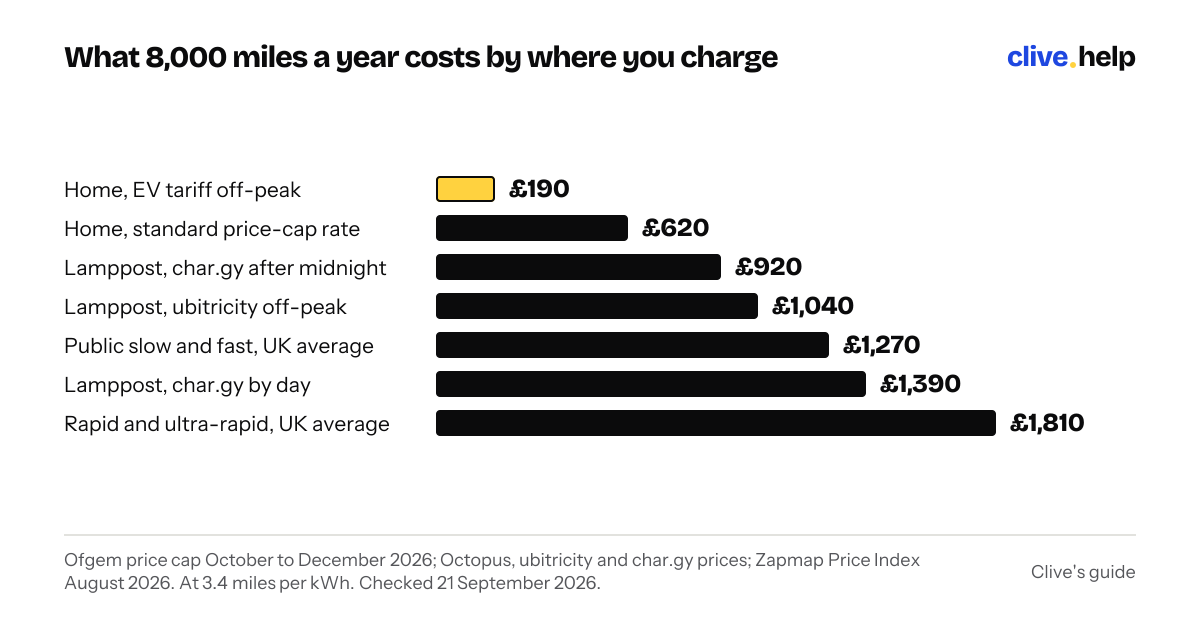
Charging at home on an EV tariff costs about 2p a mile; on your street it's 11p to 19p, and on a rapid charger about 23p, which is petrol money.
Here's the catch. The reason EVs are cheap to run is the off-peak home tariff: Intelligent Octopus Go, for example, is 8p a kWh between 11.30pm and 5.30am from 1 October 2026. Without a driveway you can't get at that rate, and public charging is priced like a shop, not like your electricity bill.
At a typical 3.4 miles per kWh, the table below is what a mile costs by where you plug in. Over 8,000 miles a year that's roughly £190 at home off-peak, £620 on the October 2026 price cap, £920 to £1,390 on lamppost chargers, and £1,810 on rapids. A 45mpg petrol car at 172p a litre, the UK average in September 2026, is about £1,390, so street charging is cheaper than petrol, rapid-only charging isn't, and the gap to a driveway is the real cost of not having one.
Two things soften it. Lamppost networks are cheaper overnight (char.gy is 39p after midnight against 59p by day), and work charging is often free or at cost. If you can get either, the sums move a long way towards the home figure. The cost guide has the full working.
What a mile costs by where you charge, at 3.4 miles per kWh, and what that comes to over 8,000 miles a year.
| Where you charge | Price per kWh | Cost per mile | 8,000 miles a year |
|---|---|---|---|
| Home, EV tariff off-peak (Intelligent Octopus Go) | 8p | 2p | £190 |
| Home, standard rate (price cap, Oct to Dec 2026) | 26.32p | 8p | £620 |
| Lamppost, overnight (char.gy, midnight to 7am) | 39p | 11p | £920 |
| Lamppost, off-peak (ubitricity, midnight to 7am) | 44p | 13p | £1,040 |
| Public slow and fast, UK average (3 to 49kW) | 54p | 16p | £1,270 |
| Lamppost, daytime (char.gy, 7am to midnight) | 59p | 17p | £1,390 |
| Rapid and ultra-rapid, UK average (50kW and up) | 77p | 23p | £1,810 |
Ofgem price cap for October to December 2026; Octopus Energy; ubitricity and char.gy published prices; Zapmap Price Index for August 2026. Last checked 21 September 2026.
Are there chargers on my street?
Only your council knows for certain, and about half of UK councils still have no on-street chargers at all, so check the map before you check the cars.
On-street charging is patchy: Vauxhall's 2026 survey of councils found half have no on-street chargers at all. Some boroughs have a lamppost charger on every other street; some counties have none. The two big networks are ubitricity (Shell) and char.gy, and most of their posts are in cities and on the edges of them.
Two quick checks: type your postcode into the box at the top of this page and I'll count what's within half a mile, a mile and three miles of you. Then open the Zapmap app and look at the street view: a charger that's always occupied or always broken is not a charger. If there's nothing within a mile, ask your council whether it has a request scheme, because most do, and then be patient.
Could I charge at work instead?
If your car sits in a work car park for eight hours, one 7kW socket there replaces a driveway entirely.
This is the option people forget. A car parked at work from nine to five on a 7kW charger takes on 50kWh, which is a full battery for most family EVs, so two days a week covers 8,000 miles a year. Employers pay whatever they like, and many charge at cost or nothing.
The Workplace Charging Scheme pays 75% of the cost of buying and fitting chargers, up to £500 a socket and 40 sockets, until 31 March 2027. If your employer hasn't got chargers, that's the number to put in the email. The asking guide has one you can copy.
Can I run a cable across the pavement?
Not loose over the pavement, but a channel set into it is legal with council permission, and there's a £500 grant towards the charger.
A cable lying across a pavement is a trip hazard and most councils will tell you to take it up. A cross-pavement channel, a narrow slot in the paving with a lid that the cable sits in, is different: the government published guidance for councils in 2025 and a growing number approve them.
You need to park outside your own house reliably, a hard-paved footway, and the council's written permission. The channel and a home charger together cost about £1,300 to £2,300 fitted, less on a council scheme, and the on-street chargepoint grant pays 75% of the charger, up to £500. Then you charge at home rates. It's the one route back to the 2p mile, and there's a guide to the rules and the cost.
How many miles a year is too many?
Above about 15,000 miles a year with only public charging, you'd be plugging in three or more times a week, and that's when most people give up.
A charge on a typical family EV is 200 to 250 real miles. At 8,000 miles a year that's one stop a week; at 12,000 it's one and a half; at 15,000-plus it's three, and every one of them is a walk, a wait or a detour. That's the point where the money and the hassle both stop making sense without a plug of your own or at work.
Long trips are a separate question. 150 miles or more in a day means a 20 to 30 minute rapid stop on the way, whatever your parking. Once a month that's a coffee; every week it's a habit you need to be honest about.
When would you tell me not yet?
When there's nothing walkable, no rapid within three miles, and you drive more than 10,000 miles a year: that's a life spent hunting for a charger.
I say it in the check, and I'll say it here. No charger within a mile, no rapid within three, and a middling-to-high mileage adds up to a car you can't easily feed. You'd make it work for a month and resent it by the third. Wait, and watch three things: your council's on-street plans, your employer's car park, and your street's eligibility for a pavement channel. Any one of them changes the answer.
If you do have a charger a short walk away, or work has one, then it's a yes with a routine attached. The one below is what that routine looks like for a real week.
Sources
- RAC Foundation, Standing Still: households without off-street parking, checked 21 September 2026
- Zapmap: how many charge points are there in the UK, June 2026, checked 21 September 2026
- Zapmap Price Index, August 2026, checked 21 September 2026
- Ofgem: energy price cap unit rates and standing charges, 1 October to 31 December 2026, checked 21 September 2026
- Octopus Energy: Intelligent Octopus Go rates, checked 21 September 2026
- Zapmap network guide: char.gy prices, checked 21 September 2026
- ubitricity: pricing from 1 April 2026, checked 21 September 2026
- GOV.UK Find a grant: Workplace Charging Scheme, checked 21 September 2026
- PetrolPrices.co.uk fuel price index, week ending 21 September 2026, checked 22 September 2026
- Fleet World: half of UK councils still lack on-street EV charging (Vauxhall Electric Streets FOI survey, May to July 2026), checked 22 September 2026
Read next
- Public vs home charging: what a mile really costsHome off-peak charging costs about 2p a mile, a lamppost charger 11p to 19p, a rapid 23p. The price per kWh for each, the sums, and how to cut the bill.
- Terraced house, no driveway: a real weekly charging routineA week of EV charging from a terraced street: one overnight lamppost charge, a top-up at the shop, a rapid when it runs long. What it costs and takes.
- Charging at work: how to ask your employerEmployers get 75% of the cost of workplace chargers back, up to £500 a socket, until March 2027. What to ask for, what it costs them, and an email to copy.
- Cross-pavement cable channels: the rules and the costA channel cut in the pavement lets you charge at home rates without a driveway. Council permission, the £500 grant, £1,300 to £2,300 fitted, and who can't.
- Lamppost and on-street chargers: which councils have them?Only 39% of UK councils have on-street chargers, and most of those are in London. The ones with the most, the 39p to 66p a kWh they cost, and how to ask.
- The cheapest public charging networks in the UKMFG at 59p and Tesla at 63p a kWh are the cheapest rapid networks by card, and InstaVolt is 55p after 8pm on its app. Every big name ranked per mile.
- Can you charge at a supermarket for free?Free supermarket charging is nearly gone: a few Aldi, Asda and Sainsbury's posts. The rest cost 40p to 90p a kWh, and what a weekly shop adds in miles.
- Rapid charging once a week: is it bad for the battery?Weekly rapid charging costs about half to one percent of battery a year, not the range people fear. The fleet data, the 80% rule, heat and the warranty.