Lamppost and on-street chargers: which councils have them?
About 39% of UK councils have on-street chargers and half have none at all, so it depends where you live. Over 70% of the country's on-street chargers are in London, with Coventry the big exception. They cost 39p to 66p a kWh, which is 11p to 19p a mile, and every council has a way to ask for one.
What is a lamppost charger?
A lamppost charger is a 5kW to 7kW socket fitted to a street light or a kerbside post, which adds about 150 miles overnight and is started with a QR code or an app.
The idea is simple. Street lights already have a power supply, so a small charging socket goes into the column or into a bollard next to it, and the council doesn't have to dig up the road. ubitricity, which is Shell's lamppost business, puts the standard output at up to 5kW; char.gy says up to 7.7kW where the supply allows. Neither is fast, and that's fine, because the car is parked for the night anyway. Ten hours at 5kW is 50kWh, which is a full battery for most family EVs and about 150 miles.
Two things catch people out. There's no cable attached, so you need your own Type 2 lead in the boot, and the socket is on a lamppost, so the space next to it isn't yours. Some councils paint an EV bay; most don't. To start, you scan the QR code on the post and pay by card, Apple Pay or Google Pay, or you use an app such as Shell Recharge or Zapmap. There's no membership, no connection fee, and you pay for the kWh you took.
The two networks that matter are ubitricity, with 14,441 chargers across more than 30 local authorities in August 2026, and char.gy with 5,690. Between them that's most of the lamppost charging in Britain, and both are almost entirely in cities and their suburbs.
Which councils have the most on-street chargers?
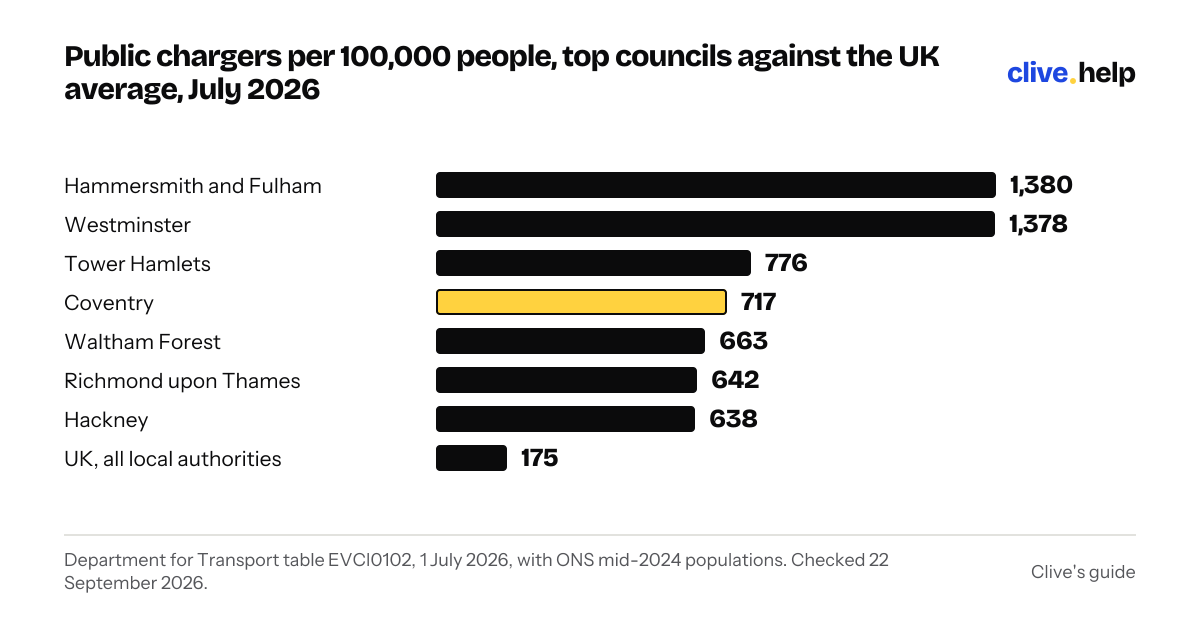
London boroughs have the most by a distance, with Hammersmith and Fulham and Westminster at around 1,380 public chargers per 100,000 people, and Coventry the only place outside London near them.
The Department for Transport counts every public charger by local authority each quarter. The table below is its 1 July 2026 list ranked by chargers per 100,000 people, which is the fair way to compare a borough with a county. It counts every public charger, not just the lamppost ones, because nobody publishes lamppost chargers council by council. But it tells you what you need to know: the top ten are nine London boroughs and Coventry, and the UK average is 175.
The on-street picture is even more lopsided. The DfT says 33% of the country's 121,171 public chargers are classed as on-street, and Vauxhall's Freedom of Information survey of 414 councils, done between May and July 2026, found that over 70% of the on-street chargers installed to the end of 2025 were in London. Outside the capital, Coventry is the model everyone points at: its partnership with Connected Kerb has put in 1,856 sockets used by more than 9,000 residents. The same survey found 39% of councils now offer on-street charging, up from 31% in 2023, and 50% still offer none.
At the other end, the counties and towns with the fewest chargers per head are places like North East Derbyshire, Castle Point and Southend, and most of Northern Ireland. If you live in one of those, the honest answer is that the lamppost network hasn't reached you yet, and the check on the pillar page will count what actually is within a mile.
The ten councils with the most public chargers per 100,000 people on 1 July 2026, from the Department for Transport's local authority table. Every public charger, not just lamppost ones.
| Council | Public chargers | Per 100,000 people |
|---|---|---|
| Hammersmith and Fulham | 2,603 | 1,380 |
| Westminster | 2,893 | 1,378 |
| Tower Hamlets | 2,574 | 776 |
| Coventry | 2,644 | 717 |
| Waltham Forest | 1,855 | 663 |
| Richmond upon Thames | 1,263 | 642 |
| Hackney | 1,701 | 638 |
| Kensington and Chelsea | 921 | 637 |
| Southwark | 1,945 | 618 |
| East Lothian | 691 | 600 |
| UK, all local authorities | 121,171 | 175 |
Department for Transport table EVCI0102, 1 July 2026, using ONS mid-2024 population estimates. The Isles of Scilly (16 chargers) is left out of the ranking. Last checked 22 September 2026.
What does a lamppost charger cost to use?
Lamppost charging costs 39p to 66p a kWh depending on the network and the time of day, which is 11p to 19p a mile at 3.4 miles per kWh.
Both big networks price by the clock, and the clock is where the money is. In September 2026 char.gy is 59p a kWh from 7am to midnight on weekdays and 39p from midnight to 7am, with a flat 54p all day at weekends. ubitricity, since 1 April 2026, is 44p off-peak from midnight to 7am, 55p from 7am to 4pm and 8pm to midnight, and 66p at the 4pm to 8pm peak. A few older posts without smart charging are a flat 54p. A session that crosses a boundary is split, so plugging in at 10pm and unplugging at 7am gets two hours at the day price and seven at the night price.
In miles, at 3.4 miles per kWh, that's 11p a mile on char.gy after midnight, 13p on ubitricity off-peak, 16p to 17p by day and 19p if you plug in at teatime. Home charging on an EV tariff is about 2p, and a 45mpg petrol car is about 17p at September 2026 pump prices, so a lamppost charger is cheaper than petrol by night and about level with it by day. Most EVs can be told to start charging at midnight, and that one setting is worth about £450 a year at 8,000 miles. The cost guide has the whole table.
How do I ask my council for one on my street?
Every council has a way to request a charger, usually an email or a form on its EV page, and a request from a named street with several EV owners on it is what moves it up the list.
Councils don't choose streets by magic. They have a list of requests, a pot of money and a contractor, and they put chargers where the pavement is wide enough, the cabling is simple and the demand is written down. Dorset, to take one, asks residents to email its EV team with a proposed spot and then checks pavement width, underground services and parking restrictions before it consults the street. Most councils work the same way; search your council's name and “on-street charging” and you'll find the page.
- Ask in writing, with the spot. Name the street, the lamppost number if it has one, and why that column: near the corner, wide pavement, no loading bay. Say you own or have ordered an EV.
- Bring the neighbours. One request is a query; five from one street is a project. A short note through doors asking who else would use it is the single most useful thing you can do.
- Register on Electric Streets of Britain. Vauxhall's campaign passes registered streets to the networks; more than 13,000 have signed up and Connected Kerb has put over 900 sockets within a 15-minute walk of registered postcodes.
- Mention the money. The Local EV Infrastructure fund gives English councils £343 million of capital for exactly this, and the On-Street Residential Chargepoint Scheme has paid £64.9 million towards 19,001 chargers since 2017. A council that says it can't afford it usually can.
- Then be patient. From request to a working socket is typically a year or more, because a public charger needs a traffic order, a contractor and a grid connection. Ask again every six months.
What if my council has none?
If there's nothing coming, your options are a charger at work, a cross-pavement channel to your own front door with a £500 grant, or a weekly stop at a rapid, and the check on this site will tell you which adds up.
Half the country is in this position, so don't take it personally. The Local EV Infrastructure fund was only starting to land in the ground this year, with 1,268 chargers provisionally funded by July 2026, so a council with none today may have a plan; ask whether it has published an on-street strategy, because 32% now have. Until then there are three real alternatives.
- Work. A 7kW socket in the work car park replaces a driveway entirely, and the grant pays the employer 75% of the cost. There's a guide to asking.
- Your own front door. If you park outside your house, a cross-pavement channel plus a home charger costs about £1,300 to £2,300, and the on-street chargepoint grant pays 75% of the charger up to £500, until 31 March 2027. It needs the council's permission and a proper channel, not a cable mat, and only 59 households had used the grant by July 2026, so you'd be an early one. The channel guide covers the rules.
- The weekly rapid. At 77p a kWh it costs petrol money, but one 20-minute stop covers a normal week, and it's how plenty of people manage. The terraced-house routine shows what that week looks like.
If none of those fits, and there's no charger within a mile and no rapid within three, my answer is not yet. Keep your request in with the council, and check back in six months: this is the fastest-changing part of the whole picture.
Sources
- Department for Transport, table EVCI0102: public EV chargers by local authority, 1 July 2026, checked 22 September 2026
- Department for Transport: public electric vehicle charging infrastructure statistics, 1 July 2026, checked 22 September 2026
- Fleet World: half of UK councils still lack on-street EV charging (Vauxhall Electric Streets FOI survey, May to July 2026), checked 22 September 2026
- Department for Transport: grant schemes for electric vehicle charging infrastructure statistics, 1 July 2026, checked 22 September 2026
- GOV.UK: Local Electric Vehicle Infrastructure (LEVI) funding allocation methodology, checked 22 September 2026
- GOV.UK Find a grant: EV chargepoint grant for households with on-street parking, checked 21 September 2026
- ubitricity: pricing from 1 April 2026, checked 21 September 2026
- ubitricity: how to charge, checked 22 September 2026
- ubitricity: lamppost and bollard chargers, checked 22 September 2026
- Zapmap network guide: Shell Recharge ubitricity, August 2026, checked 22 September 2026
- Zapmap network guide: char.gy prices, checked 21 September 2026
- char.gy help centre: how much does it cost to use char.gy?, checked 22 September 2026
- Dorset Council: residential on-street electric vehicle charging, checked 22 September 2026
- PetrolPrices.co.uk fuel price index, week ending 21 September 2026, checked 22 September 2026
Read next
- Can you own an EV without a driveway? The honest answer.Yes for many UK drivers, if chargers are a short walk from home or at work. What a mile costs against a driveway, the weekly routine, and when to wait.
- Public vs home charging: what a mile really costsHome off-peak charging costs about 2p a mile, a lamppost charger 11p to 19p, a rapid 23p. The price per kWh for each, the sums, and how to cut the bill.
- Terraced house, no driveway: a real weekly charging routineA week of EV charging from a terraced street: one overnight lamppost charge, a top-up at the shop, a rapid when it runs long. What it costs and takes.
- Charging at work: how to ask your employerEmployers get 75% of the cost of workplace chargers back, up to £500 a socket, until March 2027. What to ask for, what it costs them, and an email to copy.
- Cross-pavement cable channels: the rules and the costA channel cut in the pavement lets you charge at home rates without a driveway. Council permission, the £500 grant, £1,300 to £2,300 fitted, and who can't.