Cross-pavement cable channels: the rules and the cost
A cross-pavement channel is a narrow slot with a lid, cut into the pavement, for your charging cable. With council permission it's legal, it costs about £1,300 to £2,300 fitted with a home charger, less on a council scheme, and a £500 government grant covers 75% of the charger. Then you charge at 2p a mile, like a driveway.
What is a cross-pavement channel?
It's a narrow slot cut across the pavement from your house to the kerb, with a hinged or spring lid, that the charging cable sits in flush with the paving.
You keep a normal home charger on your front wall, and when the car is parked outside you open the lid, lay the cable in the channel, and plug in. Nothing sticks up. When you're done the lid closes and the pavement is a pavement again. Kerbo Charge, the biggest maker, sells it in 2m and 3m lengths and your contractor cuts it to the pavement width on the day; the lid is coloured to match the slabs or tarmac.
The government published guidance for councils in 2025, because it's the cheapest way to give a terraced street home charging. Councils decide street by street. Vauxhall's survey of 134 councils in April 2026 found 7 with channels in use, 21 trialling them and 28 planning them this year, so about 42% expect to offer them by the end of 2026.
Am I allowed one?
Only with your council's written permission, and only if you can reliably park outside your own house on a hard-paved footway with no verge or planting in the way.
- Council permission first. The footway belongs to the highway authority. Most now have a form; some have a policy saying no. Ask before you buy anything.
- Parking outside your own house. Not a guaranteed space, but a reasonable expectation. If you regularly end up three doors down, the channel is in the wrong place.
- A hard-surfaced pavement. The channel can't cross a grass verge, planting or an unmade surface.
- Owners and renters both. Renters need the landlord's agreement for the charger on the wall, and either can apply for the grant.
- No off-street parking at all. The grant is only for households with none; a shared car park or a garage you could use rules it out.
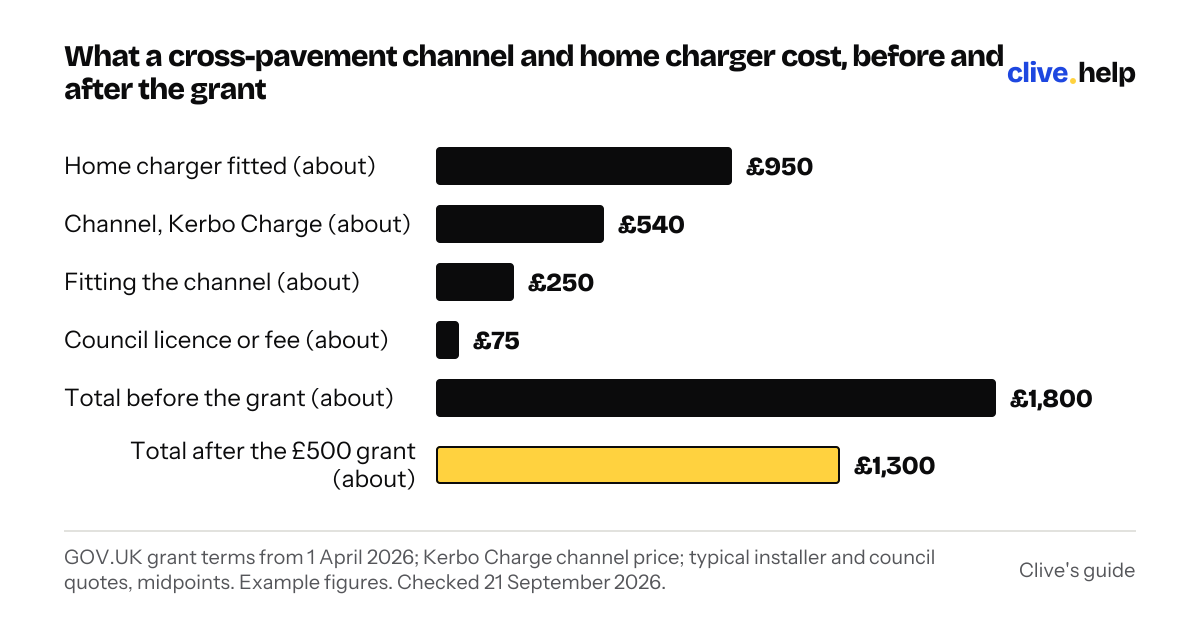
What a channel and a home charger cost together, and what the grant takes off, for a typical terraced house.
| Line | Typical cost | After the grant |
|---|---|---|
| Home charger, supplied and fitted | £800 to £1,100 | £300 to £600 |
| Cross-pavement channel, supplied (Kerbo Charge, 2m to 3m) | £499 to £579 | £499 to £579 |
| Fitting the channel (a contractor; free on some council schemes) | £0 to £500 | £0 to £500 |
| Council licence or fee | £0 to £150 | £0 to £150 |
| Total | £1,300 to £2,300 | £800 to £1,800 |
Grant terms from GOV.UK from 1 April 2026; channel price from Kerbo Charge; charger, fitting and council fees are typical quotes and vary by street. Last checked 21 September 2026.
Example figuresWhat does it cost, and what's the grant?
About £1,300 to £2,300 for the channel and a home charger fitted together, less on a council scheme, and the on-street chargepoint grant pays 75% of the charger up to £500.
The channel itself is £499 to £579 from Kerbo Charge in September 2026, plus a contractor to cut it in, and the home charger is the bigger part. Together that's about £1,300 to £2,300, though Vauxhall's April 2026 survey found council schemes ranging from free to over £1,000, so ask yours first. The EV chargepoint grant for households with on-street parking pays 75% of the charger and its installation, capped at £500, as long as a cross-pavement solution goes in at the same time and the council has approved it. From 1 April 2026 the cap rose from £350 to £500; it closes on 31 March 2027.
You don't apply yourself. An OZEV-accredited installer applies for you and takes the grant off the bill. The table shows how the sums land.
Does it pay for itself?
Yes, in one to three years at 8,000 miles: the difference between overnight lamppost charging at 11p a mile and a home EV tariff at 2p is about £700 a year.
Once the cable reaches the car, you're on your own tariff. Intelligent Octopus Go is 8p a kWh overnight from October 2026, which is 2p a mile, against 11p to 19p on the street. At 8,000 miles a year that's £190 instead of £920 to £1,390, so the £800 to £1,800 you paid comes back in one to three years, and every year after that is £700 or more in your pocket.
The cost guide has the per-mile working. If you can't get a channel, the street routine is the next best thing.
How do I get one?
Check your council's policy, get an approved installer to survey the footway, apply for permission with the installer's drawing, and let the installer claim the grant.
- Search your council's website for “cross-pavement” or “footway channel”. If there's a policy, read it; if there isn't, email highways.
- Get an OZEV-accredited installer who fits channels to survey the pavement and confirm the house-to-kerb run and the paving is suitable.
- Apply to the council with the installer's drawing. Expect a licence, sometimes a small fee, and conditions about keeping the lid closed.
- Book the install. The installer applies for the grant; it comes off your invoice.
- Switch to an EV tariff the same week. The channel only pays off if the overnight rate is behind it.
Sources
- GOV.UK: cross-pavement solutions for charging electric vehicles, checked 21 September 2026
- GOV.UK Find a grant: EV chargepoint grant for households with on-street parking, checked 21 September 2026
- Octopus Energy: Intelligent Octopus Go rates, checked 21 September 2026
- Kerbo Charge: channel prices, 2m and 3m, checked 22 September 2026
- Transport + Energy: 42% of councils to have cross-pavement charging by the end of 2026 (Vauxhall FOI survey of 134 councils, April 2026), checked 22 September 2026
Read next
- Can you own an EV without a driveway? The honest answer.Yes for many UK drivers, if chargers are a short walk from home or at work. What a mile costs against a driveway, the weekly routine, and when to wait.
- Public vs home charging: what a mile really costsHome off-peak charging costs about 2p a mile, a lamppost charger 11p to 19p, a rapid 23p. The price per kWh for each, the sums, and how to cut the bill.
- Terraced house, no driveway: a real weekly charging routineA week of EV charging from a terraced street: one overnight lamppost charge, a top-up at the shop, a rapid when it runs long. What it costs and takes.