The best EV tariffs in the UK, and which to pick
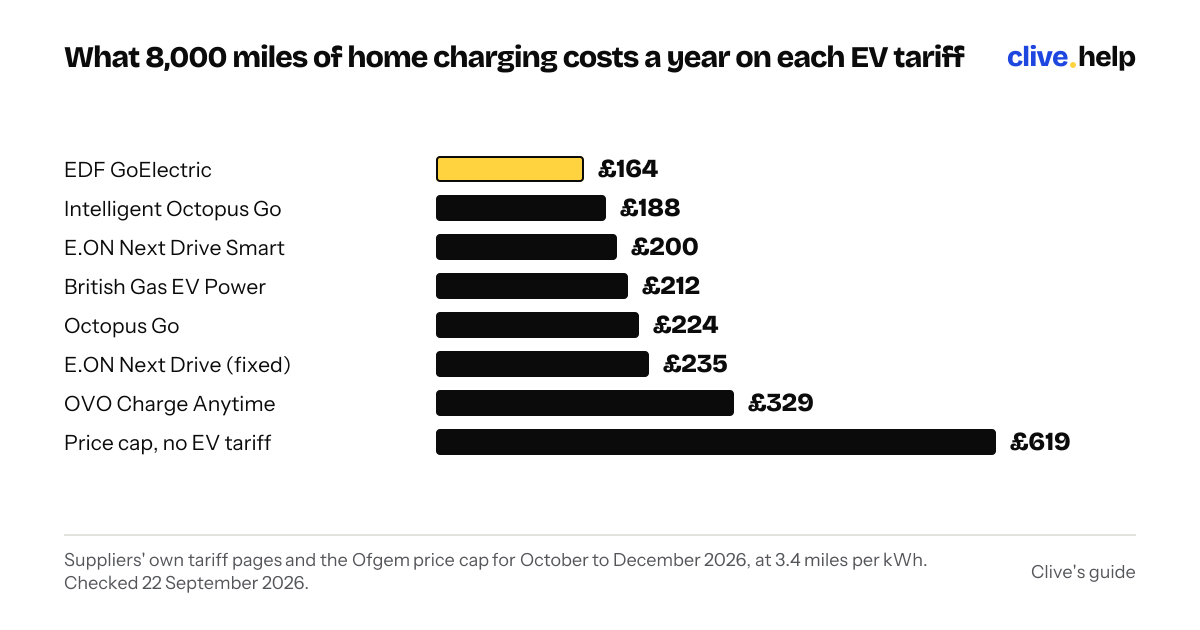
EDF GoElectric at 6.99p a kWh, Intelligent Octopus Go at 8p and E.ON Next Drive Smart at 8.5p are the cheapest off-peak rates in September 2026, for 6 or 7 hours a night. On any of them 8,000 miles costs £165 to £200 against £620 on the price cap; the catch is a 30p to 35p daytime rate.
Which EV tariff has the cheapest off-peak rate?
EDF GoElectric is the cheapest fixed-window tariff at 6.99p a kWh, with Intelligent Octopus Go at 8p and E.ON Next Drive Smart at 8.5p just behind it.
The whole point of an EV tariff is one number: what a kWh costs in the small hours. In September 2026 the spread among the big suppliers runs from 6.99p to 14p, and the table below has all of them. At 3.4 miles per kWh, 6.99p is 2p a mile and 14p is 4p a mile. Petrol, at 172p a litre in the week ending 21 September 2026 and 45mpg, is about 17p a mile, so even the dearest EV tariff is a quarter of what petrol costs.
EDF's GoElectric is the cheapest rate you can get without buying anything: any car, any charger, a smart meter and that's it. Its sister tariff, Pod Point Plug & Power, is 6.49p but only with a Pod Point charger and a two-year fix with exit fees. Intelligent Octopus Go is 8p and has been the most popular for years because the six hours are only the start: Octopus can add up to six more hours of cheap charging at whatever time suits the grid. E.ON's Next Drive Smart works the same way at 8.5p, correct as of 11 September 2026. British Gas EV Power is 9p, Octopus Go is 9.5p, and E.ON's plain Next Drive is 10p.
The odd one out is OVO Charge Anytime at 14p, a rate set on 4 November 2025, which isn't an off-peak rate at all. OVO charges the car when it likes, day or night, and bills those units at 14p while the rest of the house stays on your ordinary tariff. Dearest per kWh for the car, but it's the only one with no catch for the house.
One thing to hold onto as you read the rest of this page: the difference between 6.99p and 8.5p is about £35 a year at 8,000 miles. The difference between any of them and the price cap is over £400. So the first decision, to get on an EV tariff at all, is worth ten times more than the second decision about which one.
How many cheap hours do I actually get?
Between 5 and 7 fixed hours a night, which on a 7kW charger is 35 to 49kWh, or roughly 120 to 165 miles of range before the price goes up.
EDF gives seven hours, 11pm to 6am. E.ON gives six, midnight to 6am. Octopus gives six on Intelligent Go, 11.30pm to 5.30am, but only five on plain Go, 12.30am to 5.30am. British Gas gives five, midnight to 5am. A 7kW home charger adds about 7kWh an hour, so five hours is 35kWh and seven is 49kWh. At 3.4 miles per kWh that's 120 to 165 miles a night, which covers most people's week in two nights.
The smart tariffs stretch this. Intelligent Octopus Go and Next Drive Smart plug your car or charger into the supplier's app, you say when you need the car and how full, and the supplier picks the slots. If it charges you at 3pm because the grid is awash with wind, those units still cost 8p or 8.5p, and on Octopus so does everything else the house uses in that half hour. For a driver doing 12,000 miles or more, or with a big battery that needs more than six hours, that is what makes the smart tariffs cheaper than the fixed ones despite the higher headline rate.
One thing to check is whether the window is whole-house or car-only. Octopus, EDF, E.ON and British Gas apply the cheap rate to everything you use in the window. OVO applies it only to the car. That decides how much of the house you can shift into the night, which is the next question.
A word on a three-pin plug. It gives about 2.3kW, so a six-hour window adds about 14kWh, or 45 miles. If you drive less than 40 miles a day that's enough, and the fixed-window tariffs don't care what the cable is. If you drive more, a 7kW charger is what turns the window into a full battery, and the home charging cost guide does the sums by battery size.
The main EV tariffs in September 2026: the cheap rate, when you get it, what the day costs, and what 8,000 miles of home charging comes to at 3.4 miles per kWh.
| Tariff | Off-peak rate | Off-peak hours | Day rate | 8,000 miles a year |
|---|---|---|---|---|
| EDF GoElectric | 6.99p | 11pm to 6am | 30.28p (July) | £164 |
| Intelligent Octopus Go | 8p | 11.30pm to 5.30am, plus smart slots | 29p to 34p by region | £188 |
| E.ON Next Drive Smart | 8.5p | Midnight to 6am, plus smart slots | 34.988p | £200 |
| British Gas EV Power | 9p | Midnight to 5am | Not published | £212 |
| Octopus Go | 9.5p | 12.30am to 5.30am | 33.72p | £224 |
| E.ON Next Drive (fixed) | 10p | Midnight to 6am | Standard rate | £235 |
| OVO Charge Anytime | 14p (car only) | Any time, OVO decides | Your standard tariff | £329 |
| Price cap, no EV tariff | 26.32p | None | 26.32p | £619 |
Suppliers' own tariff pages, checked 22 September 2026; Octopus day rates and standing charges from Sunsave (22 July 2026) and Best Chargers (August 2026) because they vary by region; Ofgem price cap for October to December 2026. The house-side sums assume 2,500kWh a year of non-car use. Last checked 22 September 2026.
What does the rest of the house pay for it?
A daytime rate of about 30p to 35p a kWh instead of the 26.32p price cap, which costs a typical house £100 to £220 a year if it shifts nothing into the night.
This is the part to check before you switch. An EV tariff is a trade: a very cheap night for a dearer day. Next Drive Smart's day rate is 34.988p. Intelligent Octopus Go and Octopus Go are set by region and, according to Sunsave's round-up of 22 July 2026, were 29p to 34p across the year, around 33.7p in most places by the summer. EDF GoElectric was 30.28p in July. British Gas says its day rate is “as close as possible” to its normal rate but doesn't publish a number. The Ofgem price cap from 1 October 2026 is 26.32p, so the daytime penalty is 4p to 9p on every unit the house uses outside the window.
Take a house using 2,500kWh a year on top of the car and shifting none of it. On Octopus at 33.7p that's about £185 a year more than the cap. On E.ON Smart at 34.988p it's about £215, and on EDF at 30.28p about £100. Set that against the car: 8,000 miles is 2,353kWh, which is £619 on the cap and £165 to £200 on these tariffs, a saving of £420 to £455. So the worst case still leaves you £200 to £350 a year ahead, and the more you drive the wider it gets.
Shift a third of the house into the window, which a dishwasher timer, a washing machine delay and an immersion heater will do without you noticing, and the penalty disappears: 830kWh at 8p is £66 against £219 at the cap, which more than pays for the other 1,670kWh at the day rate. Standing charges are within a few pence of the cap's 54.83p a day on all of them, so they don't change the answer. Do the same sum with your own numbers before you switch.
The house that should think twice is the one that can't move anything: electric heating with no timer, someone home all day with the oven on, a hot tub. For that house the daytime penalty can eat most of the car's saving, and OVO's car-only rate is the safer pick.
Do I need a smart meter or a particular charger?
Every EV tariff needs a smart meter sending half-hourly readings, and the smart ones need a car or charger the supplier can talk to as well.
No smart meter, no EV tariff: that's true of all of them, because the supplier has to know which half hour each unit was used in. If you haven't got one, the supplier fits it free, and Octopus says to allow about 14 days after that before the tariff goes live. The meter must be a SMETS2 or one of the later SMETS1 units that's been brought onto the national network, and it has to be in half-hourly mode, which you consent to when you sign up. The smart meter guide covers which meters count, how long the fitting takes, and what to do while you wait.
The fixed-window tariffs, EDF GoElectric, Octopus Go, British Gas EV Power and E.ON Next Drive, don't care what you plug in. A three-pin granny cable on a timer gets the same 9.5p as a 22kW wallbox. The smart ones do care: Intelligent Octopus Go lists more than 280 compatible cars and works with chargers such as the myenergi zappi, Hypervolt and Indra. Next Drive Smart names the same three chargers or a direct link to the car, and OVO Charge Anytime has its own list. If your car or charger isn't on the list, you get the fixed-window version instead, which is still most of the saving.
Fixes and exit fees vary. Next Drive Smart is a 12-month fix with no exit fee. EDF GoElectric is fixed for its term; Pod Point Plug & Power is two years with exit fees. Octopus offers both fixed and variable versions. Check the term before you sign, because these rates move: E.ON was 6.5p in February and is 8.5p now, and Octopus went from 8.4p to 8p in October.
Intelligent Go, Go or Agile: which Octopus tariff is right for an EV?
Intelligent Go for almost everyone with a compatible car or charger, plain Go if not, and Agile only if you can chase half-hourly prices and cope with the bad days.
Octopus gets its own question because it has three tariffs people mix up. Intelligent Go is the 8p one with the six fixed hours plus smart slots. Go is the 9.5p one with five fixed hours and no smart slots, for cars and chargers Octopus can't talk to. Agile is different in kind: no window at all, a price for every half hour of the day, published the evening before, that follows the wholesale market. On a windy night it can go below zero. On a still, cold January teatime it can go past 90p.
For a car, that means Agile is a job. You or an app has to read tomorrow's prices and pick the slots, every day, and a week of calm weather can cost more than a month on Intelligent Go. It wins for a few people: a home battery and solar, a flexible routine, and the patience to watch it. For the rest, Intelligent Go does the chasing for you at a price you already know. The Octopus comparison works a year of charging through all three with real prices.
Should the car or the charger do the scheduling?
On a smart tariff, let the supplier do it through whichever of the car or the charger it's connected to; on a fixed-window tariff, set a start time in the car and forget it.
The cheap rate is only cheap if the car charges inside it, and a car plugged in at 7pm will start charging at 7pm unless something tells it not to. Two things can: the car, through its own charging schedule, or the charger, through its app. Set both and they fight. Pick one.
On Intelligent Octopus Go or Next Drive Smart the answer is neither: the supplier controls whichever one you connected at sign-up, so leave the car's own schedule off and let the app plan the night. On EDF GoElectric, Octopus Go, British Gas EV Power and Next Drive the tariff doesn't control anything, so the car's schedule is the simplest tool: set it to start at the window's opening minute and it will do that every night for years. The scheduling guide has the steps for the common cars and chargers, and the one check that tells you it worked.
Do solar panels or a heat pump change the pick?
Solar doesn't, because exporting at 12p and charging at 8p overnight beats charging from the roof; a heat pump does, because it needs the cheap window too.
Panels first, because the instinct is wrong. A unit of sunshine exported on Outgoing Octopus earns 12p, and a unit taken overnight on Intelligent Go costs 8p, so selling the sun and charging at night leaves you 4p a unit better off than pouring the sun into the car. That flips on the standard cap or on a 4.1p export rate, and it flips again with a home battery, but on a proper EV tariff the panels pay through the house, not the car. The solar and EV guide does the sums for a 4kW roof.
A heat pump is the harder one. It runs most in exactly the hours the day rate is dearest, cold mornings and evenings, and it can use more electricity in a winter than the car does all year. A six-hour night window can pre-warm the house but can't heat it, so a house with both wants either a tariff with a cheap window long enough for the heat pump to lean on, or a heat-pump tariff with an EV add-on. The heat pump and EV guide lists the tariffs that cover both and what a year costs on each.
Which one should I pick?
Intelligent Octopus Go or Next Drive Smart if your car or charger is compatible and you drive a lot, EDF GoElectric if not, and OVO Charge Anytime if the house can't shift a thing.
- Any car, any charger, want the cheapest number. EDF GoElectric at 6.99p, seven hours, no kit to buy. The lowest day rate too, so the house pays the least for it.
- Compatible car or charger, 10,000 miles or more. Intelligent Octopus Go at 8p or Next Drive Smart at 8.5p. The extra smart hours cover a big battery or a long week, and the whole-house window at odd hours adds up.
- A house that uses a lot by day and can't move it. OVO Charge Anytime at 14p. The car costs a bit more, the house pays nothing extra, and you never have to think about a window.
- Already with British Gas and don't want to move. EV Power at 9p is fine, and a Hive charger brings it down further. But moving supplier for 2p a kWh is worth about £50 a year at 8,000 miles, so don't agonise.
- Solar on the roof. Same pick as everyone else, plus an export tariff. Charge the car at night and sell the sun.
- A heat pump as well. Read the heat pump guide first, because the car is the smaller load and the tariff has to suit the bigger one.
- No driveway. None of these help unless the cable reaches the car. The no-driveway guide is the one you want, and a pavement channel is the route back to these rates.
Whatever you pick, the steps to get there are the same, and they're at the bottom of this page. The first bill after switching is the one to read carefully: it should show two rates, and most of the car's units should be on the cheap one.
Sources
- EDF: EV tariffs (GoElectric and Pod Point Plug & Power), checked 22 September 2026
- Octopus Energy: Intelligent Octopus Go rates, checked 21 September 2026
- E.ON Next: Next Drive Smart, correct as of 11 September 2026, checked 22 September 2026
- E.ON Next: Next Drive tariffs, checked 22 September 2026
- British Gas: EV Power tariff, checked 22 September 2026
- OVO: Charge Anytime, rate from 4 November 2025, checked 22 September 2026
- Best Chargers: Octopus Go rates, correct as of August 2026, checked 22 September 2026
- Sunsave: the best EV tariffs, day rates and standing charges, updated 22 July 2026, checked 22 September 2026
- Ofgem: energy price cap unit rates and standing charges, 1 October to 31 December 2026, checked 21 September 2026
- PetrolPrices.co.uk fuel price index, week ending 21 September 2026, checked 22 September 2026
Read next
- Do you need a smart meter for an EV tariff?Every EV tariff needs a smart meter sending half-hourly readings. Which meters count, how to get one free, how long it takes, and what to do meanwhile.
- Octopus Intelligent Go vs Agile vs Go: which wins for an EV?Intelligent Go at 8p overnight suits most EV drivers, Go is the fallback without a compatible car, and Agile only wins if you can chase half-hourly prices.
- Off-peak charging: how to schedule it so you never pay the day rateSet the car or the charger to start off-peak, tell a smart tariff when you need the car, and check the app once. Steps for the main cars and chargers.
- Solar panels and EV charging: is it worth it?Panels pay through the house, not the car: export at 12p and charge at 8p overnight beats charging off the roof. When solar charging wins, and the kit.
- A heat pump and an EV on one tariffA house with both wants a cheap window the heat pump can use too. Octopus Go and Cosy, British Gas and E.ON compared, with the sums for car and heating.