Solar panels and EV charging: is it worth it?
Not for the car on its own. A 4kW roof makes 3,400 to 4,200kWh a year, mostly in summer while the car is out, and on an EV tariff a unit exported earns 12p where a unit in the car saves 8p. Panels pay through the house; the car only tips it if you're stuck on the price cap.
How much does a roof produce, and when?
A typical 4kW roof makes 3,400 to 4,200kWh a year, about 470kWh in June and 100kWh in December, with 60% of it arriving between April and August.
Start with what the roof gives you, because it isn't what the brochure implies. SolarInfo's output guide puts a 4kW system in the UK at 3,400 to 4,200kWh a year. On paper that's more than an 8,000-mile car needs, which is about 2,350kWh at 3.4 miles per kWh. In practice the two don't line up, for two reasons.
The first is the calendar. The same guide puts December at about 100kWh and June at about 470kWh, and says April to August produce roughly 60% of the year's output while November to January produce 10%. So in the months you most want to charge indoors, the roof is doing almost nothing. The second is the clock. Panels peak between eleven and three, which is when most cars are at work, at the school or at the shops. A car that's home all day on a sunny Saturday can drink from the roof; a car that commutes mostly can't.
The realistic figure for a household where the car is home some daylight hours is a few hundred to a thousand kWh a year from the roof, not the whole 2,350. Everything below works from that.
Is it better to export or to charge the car?
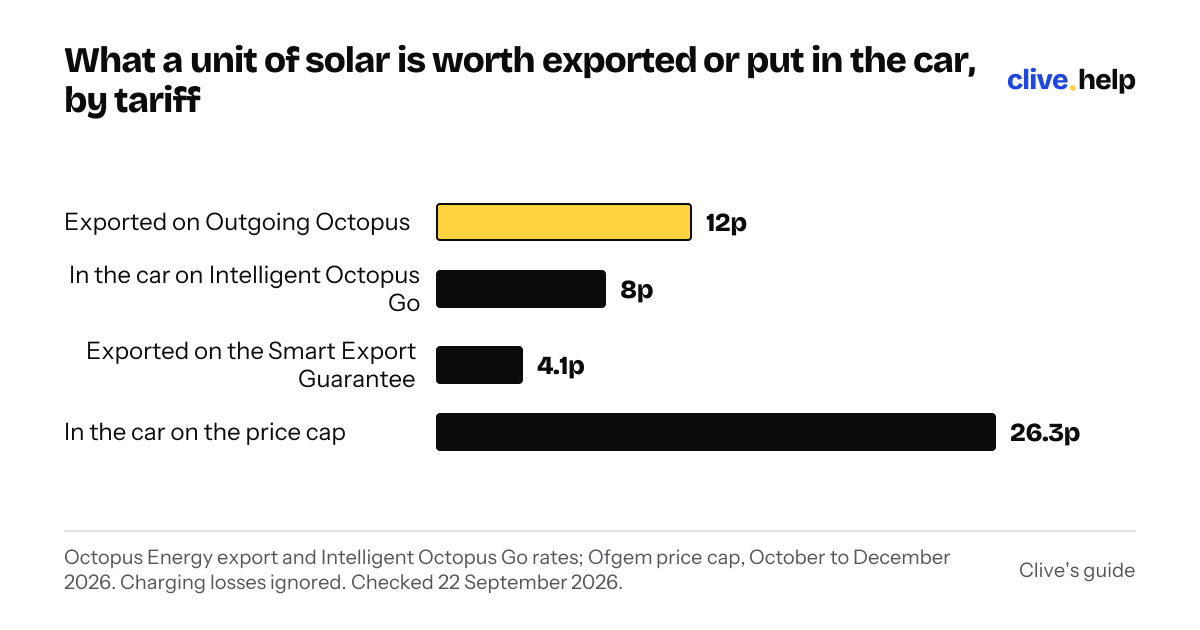
On an EV tariff, export: Outgoing Octopus pays 12p a unit and Intelligent Octopus Go charges 8p overnight, so a unit of sun is worth 4p more sold than driven.
This is the sum that surprises people. Outgoing Octopus pays 12p for every unit you export, as long as you're an Octopus customer with a smart meter and a paired import tariff. Intelligent Octopus Go charges 8p a unit between 11.30pm and 5.30am. So a unit of sunshine put into the car at lunchtime saves you 8p, and the same unit sent to the grid earns you 12p. Export it, charge at night, and you're 4p a unit better off. Over 1,000kWh a year that's £40 in favour of exporting.
The sum flips the moment you leave that tariff. On the price cap, 26.32p a unit from October to December 2026, a unit in the car saves 26p, so charging from the roof beats exporting at 12p by 14p a unit, or £143 over the same 1,000kWh. And on a basic Smart Export Guarantee rate, 4.1p at Octopus and similar elsewhere, exporting is barely worth having: charging the car beats it on every tariff. The table sets out the four combinations.
So the order matters. Get the EV tariff first, because 8p overnight is the cheapest electricity you'll ever put in a car, and the tariff comparison ranks them. Then, if you have panels, take the 12p export and let the car charge at night. Charging from the roof only wins if you're stuck on the cap, or if you can't get the 12p rate.
Whether a unit of solar is worth more exported or put in the car, by tariff, and what that comes to over 1,000kWh a year.
| Import tariff | Export tariff | Exporting earns | Charging the car saves | Better use | Difference per 1,000kWh |
|---|---|---|---|---|---|
| Intelligent Octopus Go (8p overnight) | Outgoing Octopus (12p) | 12p | 8p | Export | £40 to exporting |
| Intelligent Octopus Go (8p overnight) | Smart Export Guarantee (4.1p) | 4.1p | 8p | Charge the car | £39 to charging |
| Price cap (26.32p) | Outgoing Octopus (12p) | 12p | 26.32p | Charge the car | £143 to charging |
| Price cap (26.32p) | Smart Export Guarantee (4.1p) | 4.1p | 26.32p | Charge the car | £222 to charging |
Octopus Energy export and Intelligent Octopus Go rates; Ofgem price cap for October to December 2026. Charging losses ignored on both sides. Last checked 22 September 2026.
What charger do I need to charge from solar?
One with a solar mode and a CT clamp on your meter tail, such as a myenergi zappi from £779 or a Hypervolt Home 3 Pro from about £749, which only draw the surplus the house isn't using.
A normal 7kW charger pulls 7kW whether the sun is out or not, so on a bright afternoon it takes 2kW from the roof and 5kW from the grid at the day rate. A solar charger watches a clamp on the incoming supply and only takes what the panels are making over and above what the house is using. The two that dominate the UK market are the myenergi zappi, from £779 for the unit, and the Hypervolt Home 3 Pro, from about £749 according to Best Chargers' July 2026 review. Fitting is on top, and a straightforward install is usually a few hundred pounds.
Both work the same way. The zappi's Eco+ mode and Hypervolt's Solar mode charge only from surplus, and pause when the surplus drops below the minimum a car will accept, which is about 1.4kW. On a 4kW roof that means real solar charging happens on bright days between roughly ten and four, and stops when the kettle goes on. A hybrid mode tops up from the grid so the charge doesn't stall, and a boost mode ignores the sun altogether and charges at full speed, which is what you use at night on the EV tariff.
Both also talk to Intelligent Octopus Go, so one box does the overnight charging and the daytime solar charging. If you already have a charger without a solar mode, don't replace it for this: at 4p a unit against exporting, the difference is smaller than the cost of the swap. How to set the schedule on either is in the off-peak scheduling guide.
Does a home battery change it?
A little: a 10kWh battery costs £5,500 to £7,000 fitted, loses about 10% of what goes through it, and on an EV tariff it earns most of its keep by filling at 8p overnight rather than from the roof.
A home battery stores the midday surplus so the house can use it in the evening. Heatable's June 2026 price guide puts a 5kWh battery at £4,000 to £5,500 installed and a 10kWh one at £5,500 to £7,000, at 0% VAT until 31 March 2027. A lithium-ion battery returns about 90% of what you put in, according to the round-trip efficiency figures, so 10kWh in is 9kWh out.
For the car, it doesn't help much. The car already has a battery, a bigger one, and on an EV tariff it fills at 8p overnight. The home battery's real trick on that tariff is the same one: fill it at 8p in the small hours and run the house on it at the 30p daytime rate. On a 9kWh usable battery that's about £2 a day at most, or £600 to £700 a year if you use all of it every day, which few houses do. Against £5,500 to £7,000, that's a payback of ten years or so, and the solar surplus in summer is a bonus on top rather than the reason.
Where a battery does change the sum is a house on the price cap with no EV tariff, or a house with a heat pump running by day. The heat pump and EV guide covers that case. For a car on its own, buy the EV tariff before the battery.
So is it worth it?
Panels are worth it for the house, at about £6,260 for 4kW and a payback of ten years or so, and the car adds at most a few tens of pounds a year to the case on an EV tariff.
Here's the whole sum. The Eco Experts' cost guide, updated in June 2026, gives the MCS average as £1,565 per kW in England as of April, so a 4kW system is about £6,260 fitted, and it puts a typical home's saving at about £454 a year with a payback of just over ten years. That's the house case, and it stands or falls on its own.
Now add the car. On Intelligent Octopus Go with Outgoing at 12p, charging from the roof makes you £40 a year worse off per 1,000kWh than exporting, so the car adds nothing to the case for panels; you export the sun and charge at night. On the price cap with no EV tariff, 1,000kWh into the car from the roof saves £263 against the cap, or £222 more than exporting on SEG, which is the one situation where solar and the car are a real pairing. But an EV tariff would save you more than that on its own: 2,350kWh at 8p instead of 26p is £430 a year, with no roof at all.
So my order is: EV tariff first, panels second if the house case works for you, a solar-mode charger only if the car is home by day, and a battery last. The car is cheap to run either way; the roof is a decision about the house. What a year of home charging costs on each tariff is in the home charging guide, and which tariff to pick is in the Octopus comparison.
Sources
- SolarInfo UK: solar panel output by system size and by month, checked 22 September 2026
- Octopus Energy: Outgoing Octopus export rate, checked 22 September 2026
- Octopus Energy: Smart Export Guarantee rate, checked 22 September 2026
- Octopus Energy: Intelligent Octopus Go rates, checked 21 September 2026
- Ofgem: energy price cap unit rates and standing charges, 1 October to 31 December 2026, checked 21 September 2026
- myenergi: zappi EV charger, price and modes, checked 22 September 2026
- Best Chargers: Hypervolt Home 3 Pro review, solar modes and price, updated 14 July 2026, checked 22 September 2026
- Heatable: home battery storage cost in the UK, updated 9 June 2026, checked 22 September 2026
- Wikipedia: round-trip efficiency of lithium-ion batteries, checked 22 September 2026
- The Eco Experts: solar panel costs in the UK, MCS average price per kW, updated 29 June 2026, checked 22 September 2026
Read next
- The best EV tariffs in the UK, and which to pickEDF, Octopus and E.ON have the cheapest EV tariffs at 6.99p to 8.5p a kWh off-peak. The rates, the hours, the day-rate catch, and which to pick for you.
- Octopus Intelligent Go vs Agile vs Go: which wins for an EV?Intelligent Go at 8p overnight suits most EV drivers, Go is the fallback without a compatible car, and Agile only wins if you can chase half-hourly prices.
- A heat pump and an EV on one tariffA house with both wants a cheap window the heat pump can use too. Octopus Go and Cosy, British Gas and E.ON compared, with the sums for car and heating.