Octopus Intelligent Go vs Agile vs Go: which wins for an EV?
Intelligent Octopus Go, for most people. Its 8p a kWh between 11.30pm and 5.30am makes 8,000 miles about £190 a year, against £225 on Octopus Go at 9.5p and roughly £330 on Agile at its 2025 to 2026 overnight average of 14p. Agile only wins if you have a home battery or can move the whole house around the price.
What is the difference between the three?
Go gives you a fixed cheap window every night, Intelligent Go gives you the same window plus extra cheap hours it picks for you, and Agile has no window at all, just a price that changes every half hour.
All three are Octopus tariffs for people with a smart meter, and they solve the same problem three different ways. Octopus Go is the plain one: five cheap hours from 12.30am to 5.30am every night, 9.5p a kWh in August 2026, and the day rate the rest of the time. Any car, any charger, a timer and you're done.
Intelligent Octopus Go is Go with a brain. The fixed window is six hours, 11.30pm to 5.30am, at 8p a kWh from 1 October 2026 (8.4p until then). On top of that, Octopus can add up to six more hours of charging at the same 8p, inside the window or outside it, at whatever time suits the grid. You tell the app when you need the car and how full; it does the rest. The catch is the word compatible: your car or your charger has to be one Octopus can talk to, and the list changes.
Agile Octopus throws the window away. Every afternoon, between 4pm and 8pm, Octopus publishes 48 half-hourly prices for the next day, worked out from the wholesale market. The formula is roughly 2.2 times the wholesale price plus an extra 11p to 14p between 4pm and 7pm, with a hard ceiling of 100p a kWh. Cheap when the wind blows and the country is asleep, dear when everyone puts the kettle on. There is no EV in the rules at all; it's a tariff for people who will move their electricity to where the price is.
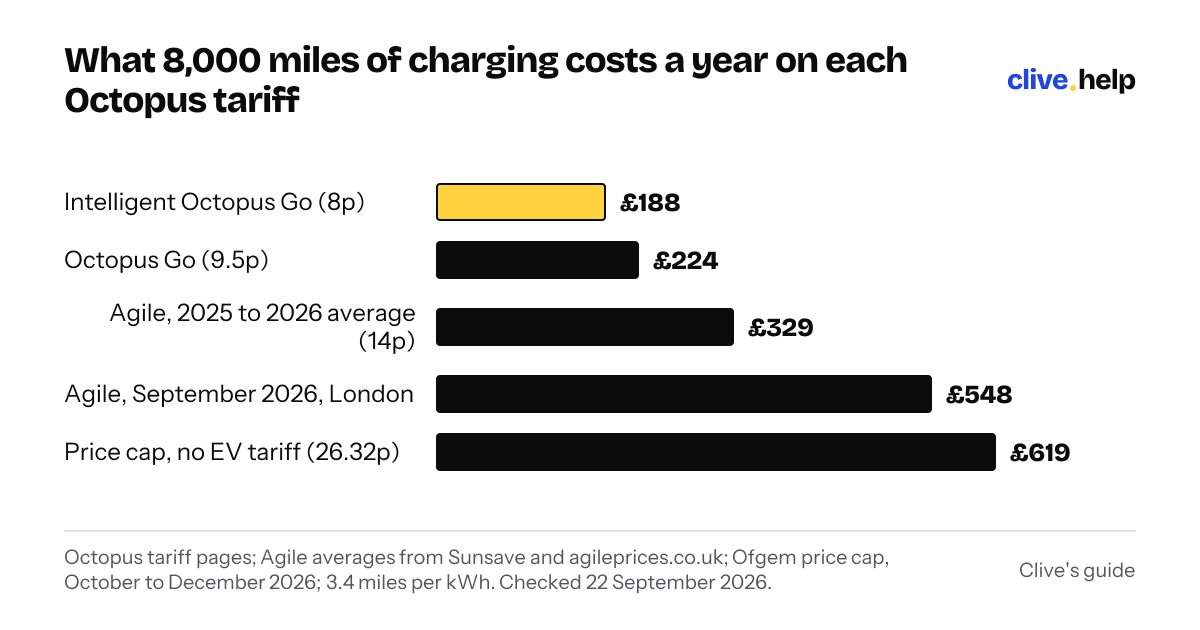
What does a year of charging cost on each?
About £190 on Intelligent Go, £225 on Go and £330 on Agile for 8,000 miles, against £620 on the price cap, with Agile the least certain of the three.
8,000 miles at 3.4 miles per kWh is 2,353 units. On Intelligent Go at 8p that's £188. On Go at 9.5p it's £224. On the October to December 2026 price cap of 26.32p, with no EV tariff, it's £619. Those three are fixed prices and the sums are just multiplication.
Agile is the one you have to estimate. Sunsave's average for 2025 to 2026 puts the overnight and midday rate at 14p a kWh, the 4pm to 7pm peak at 34p and the evening at 20p. If every unit for the car went in overnight at that 14p, the year is £329. But this September has been dearer: agileprices.co.uk shows a London month average of 25.8p, with 23.3p outside the peak and 43.7p in it, and the West Midlands a penny or two higher. Charge on a run of weeks like that and the car costs the same as it would on the price cap. Charge on a windy Sunday like 20 September, when the off-peak average was 6.4p, and it costs almost nothing. That spread is the whole point, and the whole risk.
The table below puts the three side by side with the cap. The Agile row uses the 2025 to 2026 overnight average, because a year is the fair length to judge it over, and says so.
The three Octopus tariffs and the price cap, in September 2026, with what 8,000 miles of charging costs on each at 3.4 miles per kWh.
| Tariff | Cheap rate | When | Day or peak rate | 8,000 miles a year |
|---|---|---|---|---|
| Intelligent Octopus Go | 8p (from 1 October) | 11.30pm to 5.30am, plus up to 6 smart hours | 34.32p by region (July) | £188 |
| Octopus Go | 9.5p | 12.30am to 5.30am | 33.72p by region (August) | £224 |
| Agile Octopus, 2025 to 2026 average | 14p overnight and midday | Changes every half hour | 34p at 4pm to 7pm, capped at 100p | £329 |
| Agile Octopus, September 2026 (London) | 23.3p outside the peak | Changes every half hour | 43.7p at 4pm to 7pm | £548 |
| Price cap, no EV tariff | 26.32p | None | 26.32p | £619 |
Octopus Energy tariff pages for Intelligent Octopus Go, Octopus Go and Agile; Octopus Go rates from Best Chargers (August 2026); Intelligent Go day rate from Sunsave (22 July 2026); Agile averages from Sunsave (2025 to 2026) and agileprices.co.uk (September 2026, London); Ofgem price cap for October to December 2026. Last checked 22 September 2026.
When does Agile actually win?
When you have a home battery, or a household that can genuinely move its big loads to the cheap half hours and stay off the 4pm to 7pm peak, especially in summer.
Agile beats Intelligent Go in three situations, and none of them is “I have an EV”.
- A home battery. A battery can fill up in the cheapest half hours, plunge prices included, and run the house through the 4pm to 7pm peak. That turns Agile's worst hours into its best, and it's the setup most Agile enthusiasts actually have.
- Flexible big loads. A heat pump, storage heaters, an immersion heater or an electric car that's at home in the daytime can all be pointed at the cheap slots. The car alone isn't enough, because Intelligent Go already gives it 8p without any effort from you.
- Summer. Plunge pricing is a windy-afternoon thing. Sunsave notes it's much rarer in winter, when demand is about 25% higher, and that is exactly when the 4pm to 7pm premium bites hardest.
Where Agile loses is a dark, still week in January with the car charging overnight and the house cooking at 6pm. The overnight units might be 20p, the teatime ones 45p, and Intelligent Go would have been 8p and 34p for the same day. If you can't say with a straight face that you'll check tomorrow's prices at 4pm and act on them, you won't, and Agile is not for you. The scheduling guide is the fixed-window way of doing the same job with no daily attention.
What does the rest of the house pay?
About 34p a kWh by day on both Go tariffs against a 26.32p cap, which costs a house using 2,500kWh a year around £200 unless it moves some of it into the cheap window; on Agile the house pays whatever the half hour costs.
This is the trade every EV tariff makes. Intelligent Go's day rate was 34.32p in July 2026 and Go's 33.72p in August, both set by region, against a cap of 26.32p from October. Standing charges are within a couple of pence of the cap's 54.83p a day, so they don't change the answer. A house using 2,500kWh a year on top of the car, and shifting none of it, pays about £200 more on either Go tariff than it would on the cap. The car's £430 saving still wins, but only by half.
Shift a third of it, which a dishwasher timer, a delayed wash and an immersion heater will do without you noticing, and the penalty goes. On Intelligent Go the whole house gets 8p in the window, not just the car, and it gets 8p in the extra smart slots too, which is a quiet advantage over plain Go.
On Agile the house pays the same half-hourly price as the car. In September 2026 that averaged 25.8p in London, so a house that ignores the prices comes out about level with the cap; one that cooks at 5pm every day pays 43p for the privilege, and one that runs the washing at 2am pays a fraction. Same tariff, three different bills, and the difference is entirely you. The whole-house sums for every supplier's EV tariff are on the tariff comparison.
Which one should I pick?
Intelligent Go if your car or charger is on the list, Go if it isn't, and Agile only if you have a battery or a household you'll actively run around the price.
- Compatible car or charger. Intelligent Octopus Go. 8p, six hours plus the smart extras, and the house gets the cheap rate in every one of them. This is the answer for most EV drivers, and I'd take it before I looked any further.
- Not on the list, or don't want Octopus controlling the car. Octopus Go. 9.5p for five hours is £36 a year dearer than Intelligent Go at 8,000 miles, which is not worth agonising over, and a three-pin cable on a timer gets it.
- Home battery, or big flexible loads and the habit of checking. Agile. Budget on the 14p average, expect some months at 23p, and treat plunge days as a bonus. If you get a battery later, revisit this.
- No smart meter yet. None of them, until it's fitted. The smart meter guide covers how long that takes and what to do meanwhile.
One more thing, because people ask: you can switch between the three without leaving Octopus, and Go and Intelligent Go are fixed for their term while Agile is variable by nature. If Agile turns out to be a chore, the way back to 8p is a form, not a penalty.
Sources
- Octopus Energy: Intelligent Octopus Go rates, checked 21 September 2026
- Octopus Energy: Octopus Go, checked 22 September 2026
- Best Chargers: Octopus Go rates, correct as of August 2026, checked 22 September 2026
- Sunsave: the best EV tariffs, Intelligent Octopus Go day rate and standing charge, updated 22 July 2026, checked 22 September 2026
- Octopus Energy: Agile Octopus, checked 22 September 2026
- Octopus Energy: Agile pricing explained, checked 22 September 2026
- Sunsave: Agile Octopus, is it worth it? Average rates for 2025 to 2026, updated 19 June 2026, checked 22 September 2026
- agileprices.co.uk: Agile Octopus averages, September 2026 (London and West Midlands), checked 22 September 2026
- Ofgem: energy price cap unit rates and standing charges, 1 October to 31 December 2026, checked 21 September 2026
Read next
- The best EV tariffs in the UK, and which to pickEDF, Octopus and E.ON have the cheapest EV tariffs at 6.99p to 8.5p a kWh off-peak. The rates, the hours, the day-rate catch, and which to pick for you.
- Do you need a smart meter for an EV tariff?Every EV tariff needs a smart meter sending half-hourly readings. Which meters count, how to get one free, how long it takes, and what to do meanwhile.
- Off-peak charging: how to schedule it so you never pay the day rateSet the car or the charger to start off-peak, tell a smart tariff when you need the car, and check the app once. Steps for the main cars and chargers.