Do you need a smart meter for an EV tariff?
Yes. Every EV tariff needs a smart meter that sends half-hourly readings, because the supplier has to know which units you used at 2am. A second-generation meter works everywhere; some first-generation ones do too. It's free, your supplier must offer an appointment within 6 weeks, and the fitting takes about an hour.
Why does an EV tariff need a smart meter?
Because an EV tariff charges a different price at 2am and 2pm, and only a smart meter can tell the supplier which units were used when.
An ordinary meter counts units. It has no idea whether you used them at teatime or in the small hours, so the only fair price a supplier can give you is one price for everything. An EV tariff is the opposite idea: Intelligent Octopus Go sells electricity at 8p a kWh between 11.30pm and 5.30am and a lot more the rest of the day. To bill that, the supplier needs a reading for every half hour, and that is what a smart meter sends, on its own, over its own network.
So there is no EV tariff without one, on any supplier. The good news is that this is now the normal meter: the government's June 2026 count puts 42 million smart and advanced meters in homes and small businesses, 72% of all meters, so the odds are you already have one. The question is whether it's the right kind, and whether it's working.
Which smart meters count?
A second-generation (SMETS2) meter works with every supplier's EV tariff, and a first-generation (SMETS1) meter works once it has been moved onto the national network, which most now have.
There are two generations. SMETS2 meters, fitted since about 2018, talk to a national network run by the Data Communications Company, so any supplier can read them and they keep working when you switch. SMETS1 meters, the first wave, were tied to the supplier that fitted them and went “dumb” if you moved. The DCC has spent years migrating them: 10 million had been moved by January 2023, and the DCC now says the vast majority of eligible SMETS1 meters are on the network and keep sending readings after a switch.
Suppliers still hedge on the first generation. Octopus says it can connect to any SMETS2 meter and some SMETS1 meters, naming those made by Secure, and its Go tariff page says the same. The practical test is simpler than the acronym: log in to your supplier's app or account. If it shows a reading for every half hour, you have a meter that counts. If it shows one reading a month, or nothing since you switched, you have a meter in “dumb” mode, and the fix is the same as having no smart meter at all.
Working matters as much as the generation. Of the 40 million smart meters in the June 2026 count, 92% were operating in smart mode. The other 8% look smart on the wall and aren't, and an EV tariff needs the working kind.
Which meters can put you on an EV tariff, and what to do about each.
| What's on your wall | Works for an EV tariff? | What to do |
|---|---|---|
| SMETS2 smart meter, sending half-hourly readings | Yes, with every supplier | Pick a tariff; nothing to fit |
| SMETS1 smart meter, migrated to the DCC network | Usually; Octopus names Secure meters | Check the app shows half-hourly readings |
| SMETS1 smart meter that went dumb after a switch | Not until it's migrated or replaced | Ask for a replacement; it's free |
| Economy 7 two-register meter | No, but it has its own night rate | Use the night window, and ask for a smart meter |
| Ordinary credit or prepayment meter | No | Ask for a smart meter; six weeks at most |
Octopus Energy on meter compatibility; Smart DCC on SMETS1 migration; Ofgem's February 2026 rules on appointment times; GOV.UK smart meter statistics, June 2026. Last checked 22 September 2026.
How do I get one, and how long does it take?
Ask your supplier: it's free, they must offer an appointment within 6 weeks or pay you £40, and the fitting itself takes about an hour a meter.
You ask, and your supplier fits it. Smart Energy GB puts it plainly: smart meters are provided at no extra cost, so you won't pay the installer, and each meter takes about an hour, or about two hours if gas and electricity go in together. Citizens Advice adds that you don't have to accept one if you don't want one, which is the opposite of your problem.
The wait is now regulated. Under Ofgem's rules from February 2026, if you ask for a smart meter and the supplier can't offer an appointment within six weeks, it owes you £40 automatically, another £40 if the installation fails through its own fault, and £40 again if it hasn't given you a plan to fix a problem within five working days of you reporting it. Citizens Advice's older figure was 30 working days, which is about the same six weeks. So the honest timetable is: ask today, fitted within six weeks, usually sooner.
Then there's the tariff itself. The supplier has to see half-hourly readings arriving before it will put you on an EV rate, so allow a week or two after the fitting before the 8p starts. If you're switching supplier to get the tariff, do the switch and the meter request in the same week; the new supplier can take over an existing smart meter without a visit.
What can I do while I wait?
Charge on your standard rate with a timer, because it still costs about 8p a mile, and switch the whole house to the EV tariff the week the meter goes live.
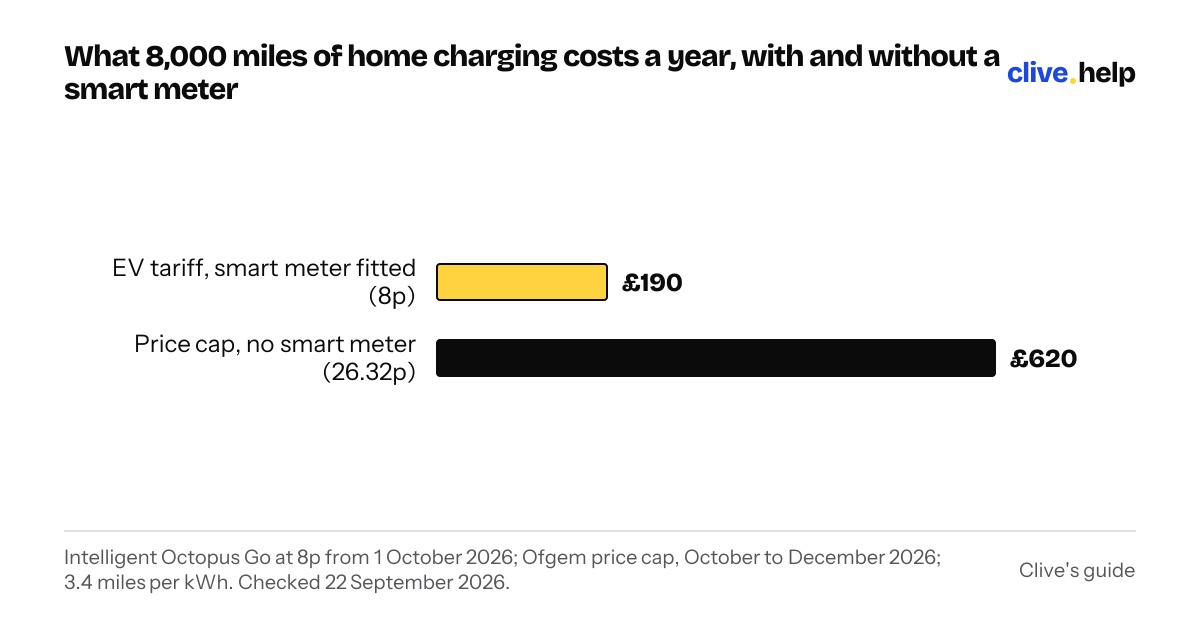
Don't put off the car for the meter. On the October to December 2026 price cap electricity is 26.32p a kWh, which at 3.4 miles per kWh is about 8p a mile, or £620 for 8,000 miles a year. That is dearer than the £190 the same miles cost on an EV tariff, but it's still less than half the price of petrol, and it's only for a few weeks.
A three-pin cable is fine for the gap. Indra puts a granny charger at 2.3kW, which adds 6 to 8 miles of range an hour, so an evening and a night on a plain socket is 80 miles or so. Use a socket on its own circuit, keep the cable out of the rain, and don't run it through an extension lead. If you've ordered a wallbox, get it fitted now: it doesn't care about the meter, and it means the cheap window is useful from the first night the tariff is live. The scheduling guide shows how to set the car so it waits for the window.
One thing to decide before the meter arrives is which tariff. The comparison ranks them; if your car or charger is on the smart list, Intelligent Go against plain Go is the usual choice, and if it isn't, a fixed-window tariff works with any car and any charger.
Is there any cheap charging without one?
Only an old Economy 7 meter, which gives a seven-hour night rate that varies by region and is nowhere near 8p, so it's a stopgap rather than a plan.
The one meter that offers a night rate without being smart is Economy 7, the two-register meter from the storage-heater era. It gives roughly seven off-peak hours, usually somewhere between midnight and 7am, at a lower unit rate and a higher day rate. Ofgem caps the pair together rather than publishing one national off-peak figure, so the rate depends on your region and supplier, and it isn't close to the 6.99p to 8p the EV tariffs charge. If you already have one, use the night window for the car and ask for a smart meter anyway.
Everything else needs the meter. There is no supplier that will sell you 8p electricity on trust, and no app that can tell them when the car charged without a meter reading behind it. If you can't have a smart meter at all, because the signal doesn't reach your cupboard or the landlord won't allow it, the sums on the home charging cost guide still work at 26.32p, and an EV still costs less to fuel than petrol. It just costs £430 a year more than it needs to.
Sources
- Octopus Energy: Intelligent Octopus Go rates, checked 21 September 2026
- Octopus Energy: what happens if I have a smart meter? (SMETS2 and Secure SMETS1), checked 22 September 2026
- Octopus Energy: Octopus Go, any car and any charger, checked 22 September 2026
- Ofgem: tougher smart meter rules from February 2026 (six-week appointments, £40 compensation), checked 22 September 2026
- Citizens Advice: getting a smart meter installed, checked 22 September 2026
- Smart Energy GB: the installation process, checked 22 September 2026
- GOV.UK: smart meters in Great Britain, quarterly update June 2026, checked 22 September 2026
- Smart DCC: upgrading first-generation (SMETS1) smart meters, checked 22 September 2026
- Smart DCC: 10 million first-generation (SMETS1) meters are now interoperable, January 2023, checked 22 September 2026
- Ofgem: energy price cap unit rates and standing charges, 1 October to 31 December 2026, checked 21 September 2026
- Indra: are 3-pin chargers for EVs safe? (2.3kW, 6 to 8 miles an hour), checked 22 September 2026
Read next
- The best EV tariffs in the UK, and which to pickEDF, Octopus and E.ON have the cheapest EV tariffs at 6.99p to 8.5p a kWh off-peak. The rates, the hours, the day-rate catch, and which to pick for you.
- Octopus Intelligent Go vs Agile vs Go: which wins for an EV?Intelligent Go at 8p overnight suits most EV drivers, Go is the fallback without a compatible car, and Agile only wins if you can chase half-hourly prices.
- Off-peak charging: how to schedule it so you never pay the day rateSet the car or the charger to start off-peak, tell a smart tariff when you need the car, and check the app once. Steps for the main cars and chargers.