How much does it cost to charge an EV at home?
About £4 for a full charge on an overnight EV tariff and £13 on the standard price cap, for a typical 50kWh battery. That's 2p a mile against 8p, using the October 2026 cap of 26.32p a kWh and Intelligent Octopus Go at 8p. A year of 8,000 miles is £190 on the tariff or £620 without it.
What does a full charge cost?
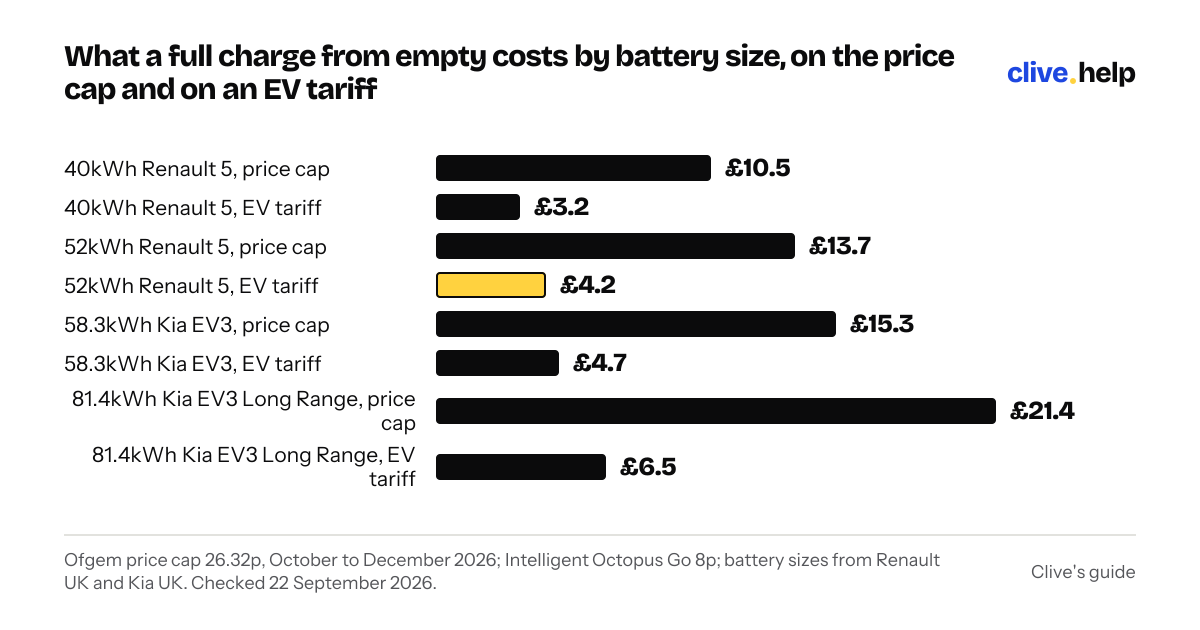
A full charge from empty costs £3.20 to £6.50 on an EV tariff and £10.50 to £21.40 on the price cap, depending on the size of the battery.
The sum is battery size times the price of a unit. From 1 October 2026 the Ofgem price cap puts standard electricity at 26.32p a kWh, so a Renault 5with the 40kWh battery costs about £10.50 to fill from empty, and a Kia EV3 Long Range with 81.4kWh costs about £21.40. On Intelligent Octopus Go the same two charges are £3.20 and £6.50, because the overnight rate is 8p.
You'll rarely do that sum in practice, because you'll rarely be empty. Most people plug in with a third or more left and top up what the day used. A 25-mile day is about 7kWh, which is 60p overnight or £1.90 on the cap, and that's the number you'll actually see most nights. The table below does the full-charge sum for five real batteries, the MG4 among them, so you can find the one nearest yours.
What does that make a mile?
At 3.4 miles per kWh a mile costs about 2p on an EV tariff and 8p on the price cap, before the small amount lost in charging.
Divide the price of a unit by the miles a unit gives you. 26.32p over 3.4 miles is 7.7p, call it 8p; 8p over 3.4 is 2.4p, call it 2p. Every per-mile figure on this site uses that 3.4, and a big SUV in January will do worse, a small hatchback in June better. Add roughly 7% to either number for what a home charger loses between the meter and the battery, which is the subject of the three-pin question below.
Set against the alternatives: petrol at 45mpg and 172p a litre in September 2026 is about 17p a mile, and public charging without a driveway is 11p to 23p, which is the whole story of the no-driveway cost guide. The 2p is the reason people who can charge at home stop thinking about fuel altogether.
What a full charge from empty costs by battery size, at the October to December 2026 price cap and on Intelligent Octopus Go, and the miles it gives at 3.4 miles per kWh.
| Battery | Car, for example | Price cap (26.32p) | EV tariff (8p) | Miles per charge |
|---|---|---|---|---|
| 40kWh | Renault 5 Urban Range | £10.50 | £3.20 | 136 |
| 51kWh | MG4 Standard Range | £13.40 | £4.10 | 173 |
| 52kWh | Renault 5 Comfort Range | £13.70 | £4.20 | 177 |
| 58.3kWh | Kia EV3 Standard Range | £15.30 | £4.70 | 198 |
| 81.4kWh | Kia EV3 Long Range | £21.40 | £6.50 | 277 |
Ofgem price cap for October to December 2026; Octopus Energy; battery sizes from Renault UK, Kia UK and EV Database. Charging losses of 5% to 24% (ADAC, August 2026) are not included; add about 7% for a wallbox. Last checked 22 September 2026.
What does a year of home charging cost?
At 8,000 miles a year home charging costs about £190 on an EV tariff and £620 on the price cap, and 12,000 miles is £280 or £930.
Miles divided by 3.4 is the units you'll buy; units times price is the bill. 6,000 miles is about 1,760kWh, so £140 overnight or £460 on the cap. 8,000 miles is 2,350kWh: £190 or £620. 12,000 miles is 3,530kWh: £280 or £930. If you want to allow for charging losses, add about 7% to each.
The gap between the two columns is the argument for an EV tariff, and it is £430 a year at 8,000 miles. It comes with a catch: the rest of the house pays a higher daytime rate for it, so a home that uses a lot of electricity by day can give some of that saving back. Which tariffs are worth it, and for whom, is in the tariff comparison. The one thing that doesn't change with any of this is road tax, which every EV now pays.
Is a three-pin plug any cheaper or dearer?
A three-pin cable costs the same per unit but wastes more of them, between 13% and 24% against 5% to 7% on a wallbox, so it adds about £60 a year on the cap.
The electricity is the same price whichever plug it comes through; the difference is how much of it reaches the battery. ADAC, the German motoring club, measured five cars in August 2026. At a household socket they lost between 12.7% (Tesla Model Y) and 24.2% (Mercedes CLA), with the Renault 5, Volvo EX30 and VW ID.7 all around 14% to 15%. On a wallbox every one of them lost between 5.1% and 7.0%. The slower the charge, the longer the car's electronics stay awake to manage it, and that's where the difference goes. E.ON's guide puts it the same way: 10% lost on a warm day with a good wallbox, 25% on a cold night with a three-pin plug.
In money, at 8,000 miles on the price cap, a wallbox losing 7% costs about £665 a year and a three-pin cable losing 15% about £730. On an EV tariff the same gap is £200 against £220. So the waste is real but it isn't the reason to buy a wallbox. The reason is the clock: a three-pin cable gives about 2.3kW, or 8 miles an hour, and the cheap window on Intelligent Octopus Go is six hours, so you can add roughly 45 miles a night at 8p and the rest at 26p. A 7kW wallbox adds 140 miles in the same window. If your daily mileage is under 40, a three-pin cable and an eligible car will do, and the tariff still works because Octopus controls the car rather than the plug.
Do solar panels change the sums?
Only a little on an EV tariff, because Octopus pays 12p a unit for exported solar and charges 8p overnight, so exporting the sun and charging at night pays better than the other way round.
A typical 4kW roof in the UK produces 3,400 to 4,200kWh a year, which on paper is more than a 12,000-mile car needs. In practice most of it arrives between May and August, in the middle of the day, when the car is usually somewhere else. Charging the car from the panels means it has to be at home in daylight, and a charger that can follow the solar output.
Then there's the price. Outgoing Octopus pays 12p in September 2026 for every unit you export, and Intelligent Octopus Go charges 8p for every unit you take overnight. So a unit of sunshine is worth 12p sold and saves you 8p if you put it in the car: export it, charge at night, and you're 4p a unit better off. The arithmetic flips if you're on the standard cap at 26.32p, or on the basic Smart Export Guarantee at 4.1p, where self-use beats export comfortably. It flips again if you have a home battery. So: on the right tariff, panels pay for themselves through the house, not the car, and the car is cheap to run either way.
Sources
- Ofgem: energy price cap unit rates and standing charges, 1 October to 31 December 2026, checked 21 September 2026
- Octopus Energy: Intelligent Octopus Go rates, checked 21 September 2026
- Renault UK: Renault 5 E-Tech electric powertrains and batteries, checked 22 September 2026
- Kia UK: EV3 specification, checked 22 September 2026
- EV Database: MG4 EV Standard Range, checked 22 September 2026
- ADAC charging-loss test of five EVs, August 2026 (reported by Zecar), checked 22 September 2026
- E.ON Next: where EV charging losses occur, checked 22 September 2026
- Octopus Energy: Outgoing Octopus export rate, checked 22 September 2026
- Octopus Energy: Smart Export Guarantee rate, checked 22 September 2026
- SolarInfo UK: solar panel output by system size, checked 22 September 2026
- PetrolPrices.co.uk fuel price index, week ending 21 September 2026, checked 22 September 2026
Read next
- What does an EV really cost to run? The whole bill.Charged at home at night, an EV costs about £200 a year less than a petrol car once tax, insurance, servicing and lost value are in. On rapids it's dearer.
- EV road tax: what you pay now, and over five yearsElectric cars pay road tax: £10 in the first year, then £200 a year, plus £440 a year for five years if the list price is over £50,000. The five-year sums.
- Is an EV dearer to insure?Not on average: 2026 quotes put an EV at £607 a year against £733 for petrol. Why repairs cost more, the cheapest EVs to cover, and how to cut the premium.
- EV servicing costs explainedAn EV service is £70 to £130 a year against £170 to £250 for petrol, on published plans. What the garage does, the intervals, tyres, brakes and the traps.