Is an EV dearer to insure?
Not on average. Confused.com's comprehensive quotes from March to May 2026 came out at £607 a year for an electric car against £733 for petrol. Repairs still cost more when an EV is hit, about 25% more on Thatcham's figures, so a small EV in a low insurance group is cheap to cover and a big one isn't.
How much more does an EV cost to insure?
On the latest comparison-site averages an EV costs less, not more: £607 a year against £733 for petrol, though a like-for-like quote for a dear or fast EV can still come out higher.
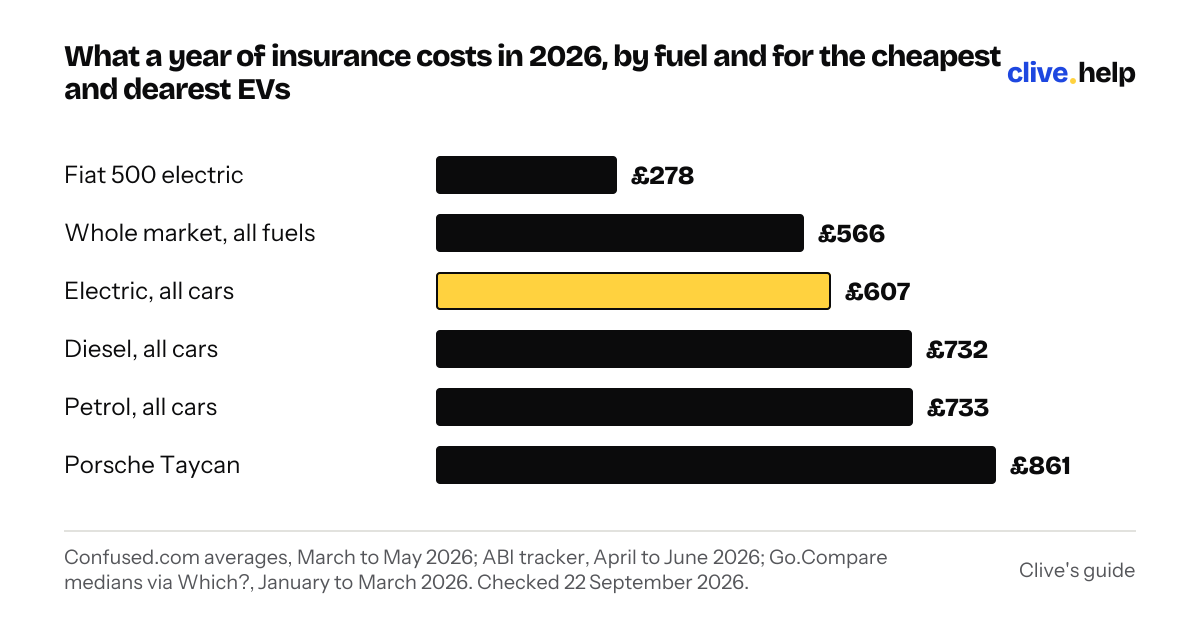
The folklore says electric cars are dear to insure, and for a few years they were. The picture has moved. Confused.com worked out its average comprehensive premium for March to May 2026 at £607 for an electric car, £733 for petrol and £732 for diesel. That's a gap of £126 in the EV's favour.
Two things to keep in mind before you cheer. It's an average of the people who bought through one site, so it says as much about who drives an EV (older, suburban, a driveway, a clean record) as about the car. And the average hides an enormous spread: the same three months of Go.Compare sales put a Fiat 500 at a median £278 a year and a Porsche Taycan at £861. Against the ABI's whole-market average of £566 in the second quarter of 2026, a small EV is cheap and a big one is dear, which is true of petrol cars too.
So the answer for you is a quote for the exact car, not the average. Get it before the test drive, because it's a line on the running-cost bill that can swing £500 either way, and it's the easiest one to check.
Why are EV repairs dearer?
Because the battery is up to 40% of the car's value, specialist parts and trained body shops are scarcer, and Thatcham found EV claims cost about 25% more and take 14% longer to repair.
An EV that gets hit costs more to put right, and that is what the premium is priced on. Thatcham Research, which sets the insurance groups, reported in July 2023 that battery-electric claims were about 25.5% more expensive than the petrol or diesel equivalent and took about 14% longer to repair. The reasons are the ones you'd guess: fewer body shops trained for high-voltage work, dearer parts, and a car that's often heavier and made of aluminium and composites rather than steel.
The battery is the real problem. In its March 2026 blueprint Thatcham says batteries account for up to 40% of a vehicle's total value, so even minor damage to the pack can turn a repairable car into a write-off, and battery issues were the first concern of 44.6% of insurers it surveyed. The same release has the good news: repair costs for EVs have fallen 10.7% as body shops get used to them, and that is why the premium gap has closed since 2023.
For scale, the ABI puts the average motor claim at £4,900 in the second quarter of 2026, up 4% on the quarter, with cameras, sensors and driver-assistance kit blamed across every kind of car. An EV has all of that plus a battery. The cost is real; it's just no longer unique to electric cars.
What electric cars cost to insure in 2026: the comparison-site averages by fuel, and the cheapest and dearest EVs by the premium people actually paid.
| Car or fuel type | Premium a year | Source and period |
|---|---|---|
| Electric, all cars | £607 | Confused.com average, March to May 2026 |
| Petrol, all cars | £733 | Confused.com average, March to May 2026 |
| Diesel, all cars | £732 | Confused.com average, March to May 2026 |
| Whole market, all fuels | £566 | ABI average, April to June 2026 |
| Fiat 500 electric | £278 | Go.Compare median, January to March 2026 |
| Mini Cooper electric | £304 | Go.Compare median, January to March 2026 |
| Dacia Spring | £333 | Go.Compare median, January to March 2026 |
| Peugeot E-208 | £349 | Go.Compare median, January to March 2026 |
| Vauxhall Corsa Electric | £352 | Go.Compare median, January to March 2026 |
| Renault 5 | £353 | Go.Compare median, January to March 2026 |
| Tesla Model X | £785 | Go.Compare median, January to March 2026 |
| Porsche Taycan | £861 | Go.Compare median, January to March 2026 |
Confused.com average comprehensive premiums, March to May 2026; ABI motor premium tracker, Q2 2026; Go.Compare sales analysed by Which?, January to March 2026. Averages depend on who buys each car, not just the car. Last checked 22 September 2026.
Which EVs are cheapest to insure?
Small ones: a Fiat 500, Mini Cooper, Dacia Spring, Peugeot E-208, Vauxhall Corsa or Renault 5 came out at £278 to £353 a year in the first quarter of 2026.
Which? asked Go.Compare to rank the EVs its customers actually insured between January and March 2026, by the median premium paid. The table below has the top of that list. The pattern is size and price: the cheapest ten are all superminis and small hatchbacks, and the dearest three are a Porsche Taycan at £861, a Porsche Macan at £837 and a Tesla Model X at £785.
Insurance groups tell the same story before you get a quote. On cinch's list the smart EQ forfour is group 9, the Renault Zoe group 14 and the Volkswagen ID.3 group 18, while Confused.com lists the Nissan Leaf at 21 to 28, the Skoda Enyaq at 22 to 38 and a Tesla Model S at group 50, the top of the scale. A group under 20 is cheap for any car; a group in the 40s is a performance-car premium whatever fuel it runs on.
If insurance is the line that decides it for you, a Renault 5 or a Corsa Electric at about £350 a year is the answer, and the Renault 5 comparison and the Corsa comparison put that next to the rest of the bill.
How do I bring the premium down?
Pick a low-group car, get the quote for the exact spec before you buy, declare your real mileage and where it sleeps, raise the excess you can afford, and compare every year.
- Quote the exact car first. Trim, battery size and options move the group. A long-range or performance version of the same EV can be ten groups higher than the base one.
- Tell them where it sleeps. A driveway or a garage is cheaper than the street. So is a low annual mileage, and most EV drivers do fewer miles than they guess: check your last MOT.
- Raise the voluntary excess to what you could pay tomorrow. Not a penny more, because a battery claim is the one you'll actually make.
- Pay annually. Monthly instalments carry interest. If you must pay monthly, a 0% card is usually cheaper than the insurer's plan.
- Check what's covered before the price. The battery, the charging cable, a home charger and roadside recovery to a charger are the EV lines; a cheap policy that leaves one out isn't cheap.
- Compare at renewal, every year. The market for EVs is moving fast: the 2026 premiums above are well below what the same cars cost to cover in 2023, and next year's will be different again.
Will EV insurance keep getting cheaper?
Probably, because the two things that made it dear, scarce repairers and untested claims data, are both fixing themselves as more EVs reach the body shop.
The 2023 gap was an information problem as much as an engineering one. Insurers had few claims to price from, so they priced for the worst case. Three years on there are more high-voltage-trained technicians, the battery-repair blueprint Thatcham published in March 2026 is aimed at stopping avoidable write-offs, and repair costs are already down a tenth. Every one of those pushes premiums the right way.
What could push them back is a bad year for battery fires or a run of expensive write-offs on one popular model, and you'll see that in the groups before you see it in your renewal. For now, insurance is one of the few running-cost lines where the EV is quietly ahead, and it's the one line people still assume goes the other way. The value it loses and the tax are where the surprises are.
Sources
- Confused.com: electric car insurance, average comprehensive premiums, March to May 2026, checked 22 September 2026
- Which?: the cheapest electric cars to insure in 2026 (Go.Compare sales, January to March 2026), 23 July 2026, checked 22 September 2026
- Thatcham Research: impact of battery electric vehicle adoption on the repair and insurance sectors, 5 July 2023, checked 22 September 2026
- Thatcham Research: Electric Vehicle Blueprint to prevent unnecessary write-offs, 3 March 2026, checked 22 September 2026
- ABI: record £3.2 billion paid out to motor insurance customers in Q2 2026, 29 July 2026, checked 22 September 2026
- cinch: cheapest electric cars to insure by insurance group, updated 24 December 2025, checked 22 September 2026
Read next
- What does an EV really cost to run? The whole bill.Charged at home at night, an EV costs about £200 a year less than a petrol car once tax, insurance, servicing and lost value are in. On rapids it's dearer.
- EV road tax: what you pay now, and over five yearsElectric cars pay road tax: £10 in the first year, then £200 a year, plus £440 a year for five years if the list price is over £50,000. The five-year sums.
- EV depreciation: how much value does it really lose?EVs lose 38 to 42% in three years against 35 to 40% for petrol, and used prices are rising after a 40-month fall. Which hold up, and how to limit it.