EV depreciation: how much value does it really lose?
About 38 to 42% in three years against 35 to 40% for petrol, on Cox Automotive's November 2025 figures, and the gap is closing. Used EV prices fell for 40 months to May 2026 and have risen since, up 3.3% in a year by July. The model matters more than the fuel: some lose 6% a year, some 18%.
How fast do EVs lose value?
An average EV loses 38 to 42% of its value in three years against 35 to 40% for a petrol car, so the gap is a few points, not the chasm it was.
The cleanest number comes from Cox Automotive, which values cars for the trade. Its figures for November 2025 put average EV depreciation at 38 to 42% after three years, against 35 to 40% for petrol. So a £30,000 EV is worth about £17,500 to £18,500 after three years and a £30,000 petrol car £18,000 to £19,500. The gap is real, but it's two or three points, and Cox says it is closing as the market settles.
Two things turn those percentages into pounds. EVs cost more to start with, so the same percentage is a bigger sum: on the running-cost page a £35,000 EV losing 40% gives up £14,000 in three years where a £28,000 petrol car losing 37% gives up £10,400, and that £1,200 a year is about what the electricity saves. And the first year is the steep one for any car, so a used EV has already had its worst year paid for by someone else.
The other side of the ledger is that petrol values are no longer the safe bet they were. Cox's first-quarter report for 2026 notes that values for petrol cars under a year old fell to 62% of new in December 2025, 12 points down over the year. The two fuels are moving towards each other from both directions.
Why did used EV prices fall, and have they stopped?
Used EV prices fell for 40 months in a row because supply outran demand, and they stopped falling in May 2026 and have been rising since.
From late 2022 the used EV market had too many cars and not enough buyers. The Electric Car Scheme puts it down to three things: a wave of three-year-old cars coming off lease and salary-sacrifice deals at once, cheaper new EVs pulling buyers away from the second-hand ones, and nervousness about batteries that priced older cars down further than they deserved. Add Tesla's new-car price cuts in 2023, which reset what every used Tesla was worth overnight, and you get the result: an average used EV that was about £39,000 in 2022 was closer to £20,000 by early 2026, and used EV prices ended 2025 down 7.4% on the year.
Then it turned. Auto Trader's index had used EV prices flat in May 2026, which ended 40 consecutive months of falls, and up 1.6% in June to an average of £24,662, the first annual rise since December 2022. By July like-for-like prices were up 3.3% on the year, with three-to-five-year-old EVs up 10.2%, against 1.0% for petrol. Demand was the driver: in April Auto Trader had EV enquiries up 59% on the year and the average used EV selling in 28 days.
So if you're buying now, the steep part of the curve is behind you. If you bought new in 2022, I'm sorry, and the arithmetic below is why I'd think hard about buying new again. One caveat from Cox: as cheaper new EVs, many of them Chinese, keep arriving, the pressure on younger used cars isn't over. The recovery is real but it isn't a promise.
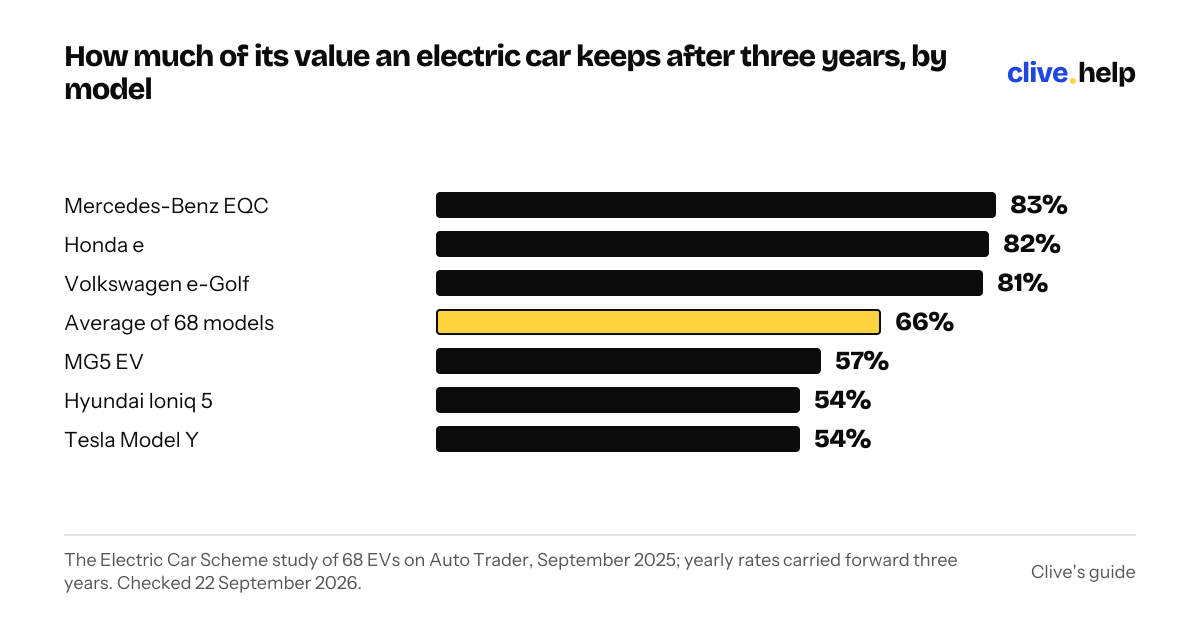
How much value electric cars lose a year by model, from The Electric Car Scheme's study of 68 EVs on Auto Trader, and what that leaves after three years.
| Model | Value lost a year | Left after 3 years |
|---|---|---|
| Mercedes-Benz EQC | 6.0% | 83% |
| Honda e | 6.6% | 82% |
| Volkswagen e-Golf | 6.9% | 81% |
| BYD Dolphin | 7.2% | 80% |
| Smart ForFour | 7.3% | 80% |
| Average of all 68 models | 12.9% | 66% |
| MG5 EV | 17.1% | 57% |
| Kia Soul EV | 17.3% | 57% |
| BMW iX | 17.3% | 56% |
| Hyundai Ioniq 5 | 18.5% | 54% |
| Tesla Model Y | 18.5% | 54% |
The Electric Car Scheme study of Auto Trader used listings, reported 1 September 2025; the yearly rates are the study's, and the three-year column carries each rate forward for three years, which is my sum, not theirs. Last checked 22 September 2026.
Which EVs hold their value best?
The spread between models is far wider than the gap between fuels: in one study of 68 EVs the best lost 6% a year and the worst 18.5%.
The fuel matters less than the badge. The Electric Car Scheme took Auto Trader listings for 68 electric models with at least three years of history and worked out how much each loses a year. The average was 12.9%. At the top, the Mercedes EQC lost 6.0% a year, the Honda e 6.6%, the Volkswagen e-Golf 6.9%, the BYD Dolphin 7.2% and the Smart ForFour 7.3%. At the bottom, the Tesla Model Y lost 18.5%, the Hyundai Ioniq 5 18.5%, the BMW iX 17.3%, the Kia Soul 17.3% and the MG5 17.1%. Only 11 of the 68 lost less than 10% a year.
Read that list carefully, because it measures what happened to used prices, not how good the cars are. The Model Y is at the bottom because Tesla cut its new price hard in 2023 and every used one followed it down; the EQC is at the top partly because it was dear and slow-selling new, so there was less height to fall from. A study like this is a rear-view mirror. What it does show is the size of the spread: two cars that cost the same new can be £8,000 apart after three years.
What holds value, according to Cox, is the boring stuff: a healthy battery with a report to prove it, decent range, rapid charging that works, a full service history and a car that's been looked after. Small, cheap, short-range EVs from brands nobody has heard of are the ones the trade marks down hardest. The table below sets out the study's best and worst, with the three-year figure carried forward from the yearly rate.
What does depreciation cost me a year?
On a £35,000 EV losing 40% over three years it's about £4,700 a year, which is more than every other running cost put together.
Take the example car from the running-cost page: £35,000 new, 40% gone in three years, so £14,000 lost, or about £4,700 a year. Set that against £190 of electricity, £200 of tax, £607 of insurance and £165 of servicing and you can see why I keep saying the car's value is the line that decides the sum. The fuel saving against petrol is about £1,200 a year with a driveway; the depreciation gap on those two cars is about £1,200 a year the other way.
Now change one thing. Buy the same EV at three years old for £21,000 and let it lose another 30% over the next three years: £6,300, or £2,100 a year. The electricity still costs £190. That's the whole case for a used EV in two sentences, and it's why the road tax and insurance lines, real as they are, aren't what to lose sleep over.
How do I protect myself from it?
Buy used or lease, pick a car people want second-hand, and if you go PCP let the guaranteed future value carry the risk instead of you.
- Buy the three-year-old one. Someone else has paid the first 40%. With 3-to-5-year-old EV prices up 10.2% in the year to July 2026, the market has already found the floor for those cars, and the battery warranty usually has five years left in it.
- Pick a car the trade likes. Long range, rapid charging, a known brand, a battery health report and a full service history. Those are Cox's five factors, and they are what the next buyer will pay for. A bargain new car from a brand with no used market can be the dearest thing you ever own.
- Lease, and let someone else guess. A lease price already has the finance company's view of the residual baked in. If they get it wrong, that's their problem. It's the cleanest way to run a new EV without owning the risk.
- On PCP, look at the guaranteed future value. The finance company promises what the car will be worth at the end. If the market falls below it, you hand the car back and walk away; if it rises above it, the difference is yours. That's a free option, so don't pay extra for it.
- Keep the paperwork. Every service stamp, every software update, and a battery report at the end. The trade prices uncertainty, and paperwork removes it.
Sources
- Cox Automotive: EV vs ICE depreciation and residual values explained, 25 August 2026, checked 22 September 2026
- Cox Automotive Insight Quarterly, Q1 2026: the used market, checked 22 September 2026
- The Electric Car Scheme: are used electric car prices still falling in 2026? (18 February 2026), checked 22 September 2026
- Auto Trader Retail Price Index, April 2026 (released 8 May 2026), checked 22 September 2026
- Bodyshop Magazine: electric vehicles drive uptick in used car prices (Auto Trader Retail Price Index, June 2026), 10 July 2026, checked 22 September 2026
- Motor Trader: used EVs see record year-on-year price growth (Auto Trader Retail Price Index, July 2026), 7 August 2026, checked 22 September 2026
- EV Powered: the best and worst EV depreciation by model (The Electric Car Scheme study of Auto Trader listings, 1 September 2025), checked 22 September 2026
Read next
- What does an EV really cost to run? The whole bill.Charged at home at night, an EV costs about £200 a year less than a petrol car once tax, insurance, servicing and lost value are in. On rapids it's dearer.
- Is an EV dearer to insure?Not on average: 2026 quotes put an EV at £607 a year against £733 for petrol. Why repairs cost more, the cheapest EVs to cover, and how to cut the premium.
- EV road tax: what you pay now, and over five yearsElectric cars pay road tax: £10 in the first year, then £200 a year, plus £440 a year for five years if the list price is over £50,000. The five-year sums.