Public vs home charging: what a mile really costs
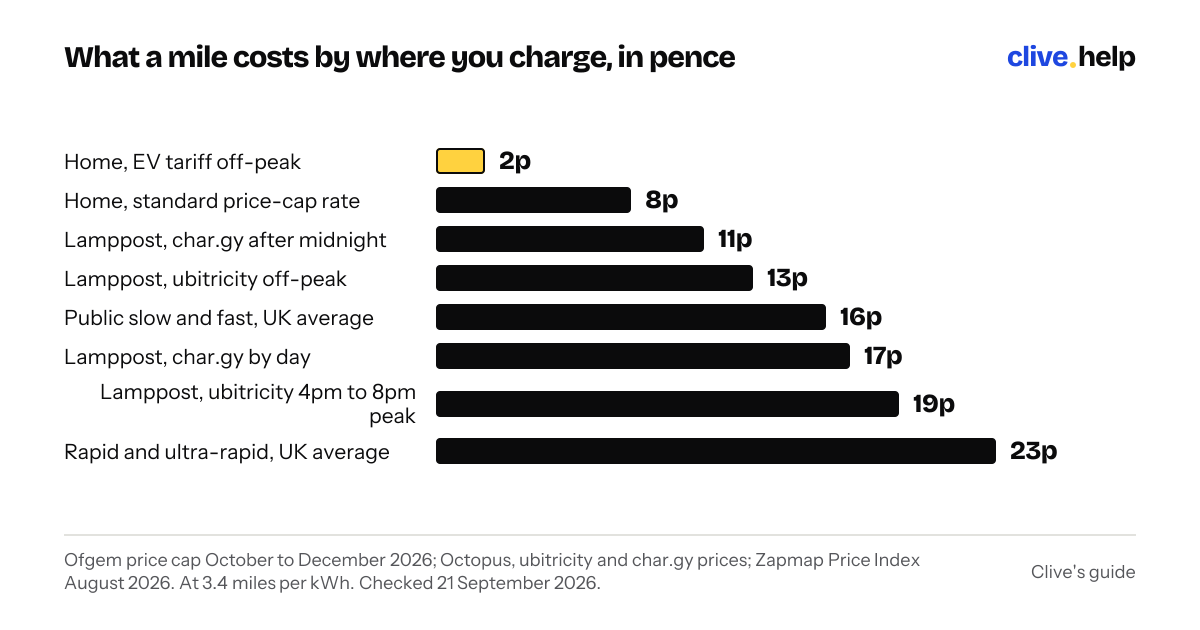
About 2p a mile at home on an EV tariff, 8p on a standard home rate, 11p to 19p on a street lamppost charger, and 23p on a rapid, using the September 2026 prices and a car that does 3.4 miles per kWh. Over 8,000 miles that's £190 at home against £920 to £1,810 on the public network.
What does charging at home cost?
Home charging costs 8p a kWh overnight on an EV tariff and 26.32p on the standard price-cap rate, which is 2p and 8p a mile.
Two numbers matter. The Ofgem price cap puts standard electricity at 26.32p a kWh from October to December 2026, so a full 50kWh charge at that rate is about £13, or 8p a mile. An EV tariff is the trick: Intelligent Octopus Go is 8p a kWh from October 2026, between 11.30pm and 5.30am, so the same charge is £4, or 2p a mile.
That 2p is why people say EVs are cheap to run, and it's the number you can't get at without a driveway or a pavement channel. Everything below is the cost of not having it.
What does a lamppost or kerbside charger cost?
Lamppost chargers cost 39p to 66p a kWh depending on the network and the time of day, which is 11p to 19p a mile.
The two big on-street networks price by time. char.gy is 59p a kWh from 7am to midnight and 39p from midnight to 7am in September 2026. ubitricity, from 1 April 2026, is 44p off-peak (midnight to 7am), 55p standard, and 66p at the 4pm to 8pm peak. So the same overnight charge that costs £4 on a driveway costs £20 to £22 on the street, and £30 if you plug in at teatime.
The lesson is in the timing. If your car sits on the street all night anyway, a network that drops its price after midnight and a car that can delay its own charging turn 17p a mile into 11p. That one habit is worth about £450 a year at 8,000 miles.
What a mile costs by where you charge, at 3.4 miles per kWh, and what that comes to over 8,000 miles a year.
| Where you charge | Price per kWh | Cost per mile | 8,000 miles a year |
|---|---|---|---|
| Home, EV tariff off-peak (Intelligent Octopus Go) | 8p | 2p | £190 |
| Home, standard rate (price cap, Oct to Dec 2026) | 26.32p | 8p | £620 |
| Lamppost, overnight (char.gy, midnight to 7am) | 39p | 11p | £920 |
| Lamppost, off-peak (ubitricity, midnight to 7am) | 44p | 13p | £1,040 |
| Public slow and fast, UK average (3 to 49kW) | 54p | 16p | £1,270 |
| Lamppost, standard (ubitricity, 7am to 4pm and 8pm to midnight) | 55p | 16p | £1,290 |
| Lamppost, daytime (char.gy, 7am to midnight) | 59p | 17p | £1,390 |
| Lamppost, peak (ubitricity, 4pm to 8pm) | 66p | 19p | £1,550 |
| Rapid and ultra-rapid, UK average (50kW and up) | 77p | 23p | £1,810 |
Ofgem price cap for October to December 2026; Octopus Energy; ubitricity and char.gy published prices; Zapmap Price Index for August 2026. Petrol comparison: 45mpg at 172p a litre, the PetrolPrices.co.uk average for the week ending 21 September 2026. Last checked 21 September 2026.
What does rapid charging cost?
The UK average for rapid and ultra-rapid charging was 77p a kWh in August 2026, or 23p a mile, with the big networks between 59p and 92p.
Zapmap's price index for August 2026 puts the weighted average at 77p a kWh for chargers of 50kW and above, and 54p for the slower public chargers from 3kW to 49kW. That's 23p and 16p a mile. Among the ten biggest rapid networks the range was 59p to 92p, so it's worth knowing which one is on your way home: the difference between the cheapest and dearest is 10p a mile.
For comparison, a 45mpg petrol car at 172p a litre, the UK average in September 2026, is about 17p a mile. Rapid-only charging costs more than petrol. Street charging, especially overnight, costs less. That's the whole picture in one sentence.
What does that add up to over a year?
At 8,000 miles a year the range runs from about £190 at home off-peak to £1,810 on rapids, with overnight lamppost charging at around £920.
Multiply the pence per mile by your miles. The table above does it for 8,000, which is about what most people who can manage without a driveway do; at 12,000 add half again. A mix is normal: two overnight lamppost charges a week and a rapid when the week goes wrong lands around £1,000 to £1,100 a year.
Against a petrol car at £1,390 for the same miles, that's £300 to £400 a year saved on fuel, before servicing and tax. Against a driveway, you're paying £700 to £900 a year for not having one.
How do I bring the cost down without a driveway?
Charge overnight on a network with a night rate, use any work or destination charger you can, and keep rapids for the weeks that need them.
- Plug in after midnight. char.gy's 39p and ubitricity's 44p are only for the small hours. Set the car to start charging at midnight and it does the waiting for you.
- Ask work. A charger in the work car park is the closest thing to a driveway there is, and the grant makes it cheap for them. See how to ask.
- Use the shop. An hour on a 7kW supermarket charger is 25 miles, sometimes free, and it's time you were spending anyway.
- Know your networks. Live prices are on the Zapmap map. A 59p rapid on the way home beats an 92p one on the way out.
- Do the sums for a channel. If you park outside your own front door, a cross-pavement channel pays for itself in two to three years at these prices.
Sources
- Ofgem: energy price cap unit rates and standing charges, 1 October to 31 December 2026, checked 21 September 2026
- Octopus Energy: Intelligent Octopus Go rates, checked 21 September 2026
- Zapmap network guide: char.gy prices, checked 21 September 2026
- ubitricity: pricing from 1 April 2026, checked 21 September 2026
- Zapmap Price Index, August 2026, checked 21 September 2026
- PetrolPrices.co.uk fuel price index, week ending 21 September 2026, checked 22 September 2026
Read next
- Can you own an EV without a driveway? The honest answer.Yes for many UK drivers, if chargers are a short walk from home or at work. What a mile costs against a driveway, the weekly routine, and when to wait.
- Terraced house, no driveway: a real weekly charging routineA week of EV charging from a terraced street: one overnight lamppost charge, a top-up at the shop, a rapid when it runs long. What it costs and takes.
- Charging at work: how to ask your employerEmployers get 75% of the cost of workplace chargers back, up to £500 a socket, until March 2027. What to ask for, what it costs them, and an email to copy.
- Cross-pavement cable channels: the rules and the costA channel cut in the pavement lets you charge at home rates without a driveway. Council permission, the £500 grant, £1,300 to £2,300 fitted, and who can't.