Terraced house, no driveway: a real weekly charging routine
One overnight charge on a lamppost or kerbside post covers a normal week of 150 miles, a supermarket top-up adds the odd 25, and a 20-minute rapid stop rescues the weeks that run long. That's about 2 plug-ins a week, 15 minutes of walking, and £18 to £25, which is no more than the £25 of petrol it replaces.
What does a normal week look like?
For 150 miles a week you need one full overnight charge and, at most, one short top-up, and the rest is just parking where you'd park anyway.
Start with the miles. 8,000 a year is about 150 a week, and that's one charge. So the routine isn't “find a charger every day”; it's “find one once”. The night it happens matters less than the habit: the same evening each week, the same post, a walk home, and a full car by morning.
A charger two streets away is fine. Five streets is fine. A mile is where people stop bothering, and the check on the no-driveway page counts what's within half a mile and a mile of your postcode for exactly that reason.
Which night should I plug in?
Whichever night the charger is usually free, and after midnight if your network is cheaper then, because that one habit cuts the bill by a third.
char.gy drops from 59p to 39p a kWh at midnight; ubitricity from 55p to 44p, at their September 2026 prices. A 50kWh charge is £30 by day and £20 after midnight on char.gy. Most EVs can be told to wait, and on a home tariff such as Intelligent Octopus Go the supplier does the waiting for you: plug in at 9pm, set “start at midnight” in the car or the app, and go to bed.
The night to pick is the one the app shows the post free, which for most streets is Sunday or Monday. Thursday and Friday are when everyone else remembers.
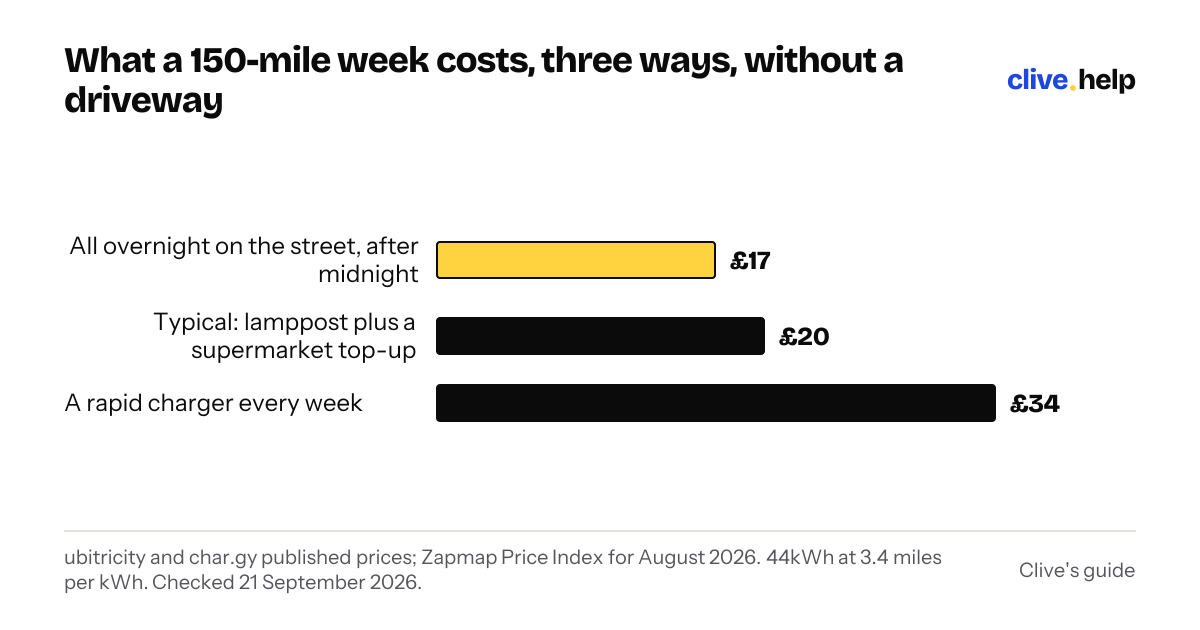
Three ways to cover the same 150-mile week, at 3.4 miles per kWh (44kWh), and what each costs.
| The week | Where the kWh come from | Cost for the week |
|---|---|---|
| All overnight on the street | 44kWh on char.gy after midnight at 39p | £17 |
| Typical | 35kWh overnight on ubitricity at 44p, 9kWh at the supermarket at 54p | £20 |
| A rapid every week | 44kWh on rapids at the 77p average | £34 |
ubitricity and char.gy published prices; Zapmap Price Index for August 2026. Last checked 21 September 2026.
Where do the top-ups come from?
The supermarket, the gym, the leisure centre or work: anywhere the car sits for an hour with a 7kW to 22kW charger next to it.
An hour on a 7kW charger is about 25 miles, on a 22kW one about 75. You're not there for the charge; you're there for the shopping, and the charge is a side effect. Some of these are still free, most are priced around the 54p public average for August 2026, and none of them need planning.
If your car sits in a work car park, the routine changes completely: two days a week on a work charger is the whole 150 miles and the lamppost becomes the backup. There's a guide to asking for one.
What happens when the week goes wrong?
A rapid charger for 20 to 30 minutes puts most of the battery back, costs about £15 to £20, and is the safety net rather than the plan.
Every few weeks the post is taken, or you did a long trip, or you forgot. That's what rapids are for: 20 minutes at a 50kW-plus charger at the retail park or on the ring road is 100 to 150 miles at about 77p a kWh. Do that every week and you're paying petrol prices, about £25 for the same 150 miles at September 2026 pump prices; do it once a month and it's a coffee.
Keep a floor. Below about 60 miles, don't gamble on tonight's post being free; go to the rapid on the way home.
What does the routine cost a week?
About £18 to £25 a week for 150 miles, depending on how much of it is overnight lamppost charging and how much is rapid.
The table shows three ways the same 150 miles can go. All overnight on char.gy is the cheapest at about £17; a rapid every week is the dearest at about £34. Most people land in the middle. The cost guide has every network's price per mile.
Sources
- Zapmap network guide: char.gy prices, checked 21 September 2026
- ubitricity: pricing from 1 April 2026, checked 21 September 2026
- Zapmap Price Index, August 2026, checked 21 September 2026
- Octopus Energy: Intelligent Octopus Go rates, checked 21 September 2026
- PetrolPrices.co.uk fuel price index, week ending 21 September 2026, checked 22 September 2026
Read next
- Can you own an EV without a driveway? The honest answer.Yes for many UK drivers, if chargers are a short walk from home or at work. What a mile costs against a driveway, the weekly routine, and when to wait.
- Public vs home charging: what a mile really costsHome off-peak charging costs about 2p a mile, a lamppost charger 11p to 19p, a rapid 23p. The price per kWh for each, the sums, and how to cut the bill.
- Charging at work: how to ask your employerEmployers get 75% of the cost of workplace chargers back, up to £500 a socket, until March 2027. What to ask for, what it costs them, and an email to copy.