Can you charge at a supermarket for free?
Almost never now. Tesco stopped in November 2022, Lidl charges everyone, and only a handful of older 7kW posts at some Aldi, Asda and Sainsbury's stores are still free. The rest cost 40p to 90p a kWh, which is 12p to 26p a mile. A weekly shop adds about 25 miles; it helps, but it won't run the car.
Which supermarkets still charge for free?
Only a few older 7kW posts at some Aldi, Asda and Sainsbury's stores are still free, and every Tesco, Lidl, Morrisons, Waitrose and M&S charger is paid.
Free supermarket charging was a real thing for about five years, and it's nearly over. Tesco, which had the biggest free network in the country, switched its Pod Point chargers to paid on 1 November 2022. Lidl took its network in-house in 2024 and charges on all 1,423 of its chargers. Morrisons, Waitrose and M&S have never really done free; their car parks are run by rapid networks that charge like a forecourt.
What's left, going by Electric Car Guide in January 2026 and Best Chargers in July, is a scattering of old 7kW Pod Point posts at some Aldi stores, a handful of slow chargers at a few Asda sites, and a very small number of older Sainsbury's posts. Nobody publishes a list, the number shrinks every time a store refits its car park, and Aldi is replacing its old posts with paid Drax ones as it refits stores. The way to find one is the Zapmap app: filter for “free”, look at your nearest stores, and then read the recent check-ins to see whether it still works and whether it's ever free when you get there.
If you do find one, it will be slow, it will have a stay limit, and it will be popular. Treat it as a bonus, not a plan. The plan is in the weekly routine.
What do the others charge?
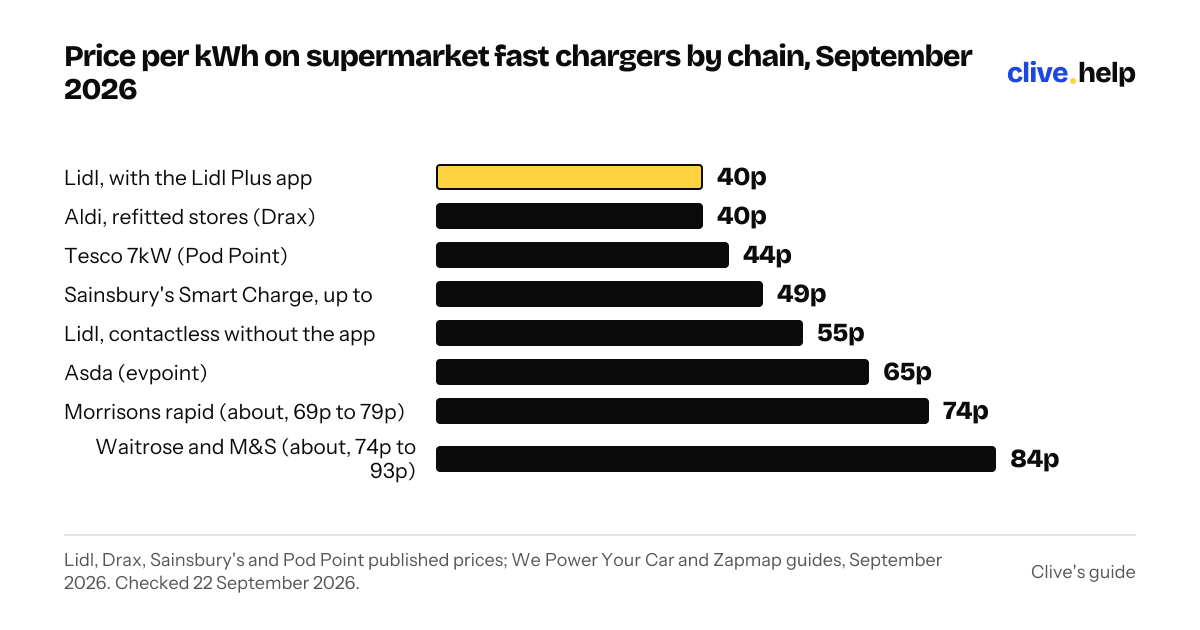
Fast 7kW to 22kW chargers cost 40p to 49p a kWh at Lidl, Aldi, Tesco and Sainsbury's, and rapids run from 59p at Lidl to 90p on GeniePoint posts at Morrisons.
The pattern is simple: the discounters are cheapest, the big four are in the middle, and anywhere a forecourt network runs the car park costs forecourt money. In September 2026 Lidl is 40p a kWh on its fast chargers and 59p on its rapids if you pay through the Lidl Plus app, and 55p and 74p if you don't. Aldi's new Drax chargers, going in from June 2026, are 40p fast and 62p rapid with contactless and no app at all. Tesco's Pod Point posts are 44p at 7kW, 49p at 22kW, 62p at 50kW and 69p at 75kW. Sainsbury's Smart Charge caps its slow chargers at 49p and its 150kW ultra-rapids at 79p, and Zapmap lists most of its sites at 72p.
Then it climbs. Asda is 65p on its evpoint chargers and 83p on GeniePoint. Morrisons is 69p to 79p on MFG EV Power and 75p to 90p on GeniePoint. Waitroseand M&S mostly have Shell Recharge and bp pulse rapids at 74p to 93p, which is the dearest electricity you can buy in a car park. For scale, the UK average rapid price in Zapmap's August 2026 index was 77p, so a supermarket rapid is about average and a supermarket fast charger is well below it.
Divide any of those by 3.4 miles per kWh and you get the cost of a mile, which is the table below. Against 2p a mile at home on Intelligent Octopus Go, the cheapest supermarket is six times dearer and the dearest is thirteen. Against petrol at about 17p a mile at September 2026 prices, the 40p fast chargers win and the 80p-plus rapids lose. The cost guide has the same sums for lamppost chargers.
What supermarket charging costs by chain, network and speed, and what that makes a mile at 3.4 miles per kWh.
| Supermarket | Network | Speed | Price per kWh | Cost per mile |
|---|---|---|---|---|
| Lidl, with Lidl Plus app | Lidl | Fast, 7 to 22kW | 40p | 12p |
| Aldi, refitted stores from June 2026 | Drax | Fast, up to 22kW | 40p | 12p |
| Aldi, older posts | Pod Point | 7kW | 44p, a few still free | 13p |
| Tesco | Pod Point | 7kW | 44p | 13p |
| Tesco | Pod Point | 22kW | 49p | 14p |
| Sainsbury's | Smart Charge | 7 to 22kW | Up to 49p | 14p |
| Lidl, with Lidl Plus app | Lidl | Rapid | 59p | 17p |
| Aldi, refitted stores | Drax | Rapid, up to 160kW | 62p | 18p |
| Tesco | Pod Point | 50kW | 62p | 18p |
| Asda | evpoint | Fast and rapid | 65p | 19p |
| Tesco | Pod Point | 75kW | 69p | 20p |
| Morrisons | MFG EV Power | Rapid and ultra-rapid | 69p to 79p | 20p to 23p |
| Lidl, contactless without the app | Lidl | Rapid | 74p | 22p |
| Sainsbury's | Smart Charge | 150kW | 72p to 79p | 21p to 23p |
| Waitrose, M&S | Shell Recharge, bp pulse | Rapid and ultra-rapid | 74p to 93p | 22p to 27p |
| Asda | GeniePoint | Rapid | 83p | 24p |
| Morrisons | GeniePoint | Rapid and ultra-rapid | 75p to 90p | 22p to 26p |
Lidl, Sainsbury's Smart Charge and Drax published prices; Tesco Pod Point prices by speed; We Power Your Car's Asda, Morrisons and Waitrose guides; Zapmap network guides for bp pulse and Shell Recharge, September 2026. Last checked 22 September 2026.
Is a weekly shop enough to run a car on?
No: an hour on a 7kW charger adds about 24 miles and a normal week needs 150, so the shop covers a sixth of it unless you use a rapid.
Do the sums with the car's appetite rather than the charger's badge. At 3.4 miles per kWh, an hour on a 7kW charger is 7kWh, which is 24 miles. An hour on a 22kW charger is 75 miles, but only if your car can take 22kW on AC, and most family EVs take 7kW or 11kW, so call it 24 to 37 miles. Half an hour on a 50kW rapid is 20 to 25kWh once the charge tapers off, which is 70 to 85 miles.
Now the week. 8,000 miles a year is 154 a week. One hour-long shop on a fast charger gives you 24 of those, a sixth of the week. Two shops and a longer stay, say three hours across the week, gives you 72 miles, nearly half. It's useful, and it's time you were spending anyway, but it isn't a car's worth of electricity on its own. A rapid changes that: one half-hour stop a week on a 62p Aldi or 69p Tesco rapid, at about £14, covers most of a normal week by itself.
So the supermarket is the second charger in your week, not the first. The first is whatever your car sits next to for eight hours: a lamppost, a work car park, or a cable channel to your own front door. If none of those exist, the no-driveway guide is where I say so.
Which supermarket is cheapest?
Lidl with the Lidl Plus app and Aldi's new Drax chargers, both 40p a kWh on the fast posts, which is under 12p a mile.
Lidl and Aldi, and it isn't close. 40p a kWh is 12p a mile, cheaper than petrol and cheaper than any lamppost charger by day. The catch at Lidl is the app: without Lidl Plus the same post is 55p, and the rapids go from 59p to 74p, so download it before you plug in rather than after. Aldi's Drax posts take contactless at the 40p price with nothing to sign up for, but they're only at the stores that have been refitted since June 2026, and the older Pod Point and Shell posts at other Aldis are 44p to 85p, per We Power Your Car's Aldi guide.
Sainsbury's is worth a mention for the rapids: 72p to 79p with a Nectar point per pound, at 150kW, which is the fastest supermarket charging there is and handy for the week that goes wrong. Everything else is priced by whoever runs the car park, and the network guide ranks those.
How long can I stay plugged in?
As long as the car park allows, which is usually two to three hours from the moment you arrive, and a parking charge of around £90 lands whether you were charging or not.
The charger doesn't have a time limit; the car park does, and the car park wins. Most supermarket car parks are run by a parking company with cameras at the gate, and the limit on the sign, usually two or three hours at Tesco and two at many Waitrose and Lidl stores, counts from the moment you drive in. Charging doesn't pause it. Finishing your charge doesn't reset it.
The charges are real. In August 2026 a driver got a £90 ticket after 16 minutes at a Lidl charger, because the car park was closed to parking outside trading hours and the sign said so; Lidl cancelled it and said it was reviewing the policy, but the sign is still the rule. So three habits: read the sign before you plug in, set a phone alarm for twenty minutes under the limit, and never leave the car overnight on a supermarket charger unless the sign says you can.
Some networks add an overstay fee of their own on top once the charge finishes and the car is still in the bay. It's rarer at supermarkets than at motorway hubs, but it's in the small print of the app, and the app tells you when the car is done. Move it.
Sources
- Electric Car Guide: supermarkets with free EV charging, 21 January 2026, checked 22 September 2026
- Best Chargers: supermarket EV charging compared, updated 14 July 2026, checked 22 September 2026
- Lidl GB: electric vehicle charging prices and payment, checked 22 September 2026
- Zapmap network guide: Lidl, checked 22 September 2026
- Drax press release, 10 June 2026: Aldi's new charging network and prices, checked 22 September 2026
- We Power Your Car: Aldi EV charging guide 2026, checked 22 September 2026
- Move Electric: Tesco and Pod Point charging prices by speed, checked 22 September 2026
- We Power Your Car: Tesco EV charging guide 2026, checked 22 September 2026
- Sainsbury's Smart Charge: prices and Nectar points, checked 22 September 2026
- Zapmap network guide: Smart Charge, checked 22 September 2026
- We Power Your Car: Asda EV charging guide, checked 22 September 2026
- We Power Your Car: Morrisons EV charging guide, September 2026, checked 22 September 2026
- We Power Your Car: Waitrose EV charging guide, checked 22 September 2026
- Zapmap network guide: Shell Recharge prices, September 2026, checked 22 September 2026
- Zapmap network guide: bp pulse prices, September 2026, checked 22 September 2026
- Zapmap Price Index, August 2026, checked 21 September 2026
- Octopus Energy: Intelligent Octopus Go rates, checked 21 September 2026
- AOL, 4 August 2026: driver gets £90 ticket after using Lidl EV charger, checked 22 September 2026
- PetrolPrices.co.uk fuel price index, week ending 21 September 2026, checked 22 September 2026
Read next
- Can you own an EV without a driveway? The honest answer.Yes for many UK drivers, if chargers are a short walk from home or at work. What a mile costs against a driveway, the weekly routine, and when to wait.
- Terraced house, no driveway: a real weekly charging routineA week of EV charging from a terraced street: one overnight lamppost charge, a top-up at the shop, a rapid when it runs long. What it costs and takes.
- The cheapest public charging networks in the UKMFG at 59p and Tesla at 63p a kWh are the cheapest rapid networks by card, and InstaVolt is 55p after 8pm on its app. Every big name ranked per mile.
- Public vs home charging: what a mile really costsHome off-peak charging costs about 2p a mile, a lamppost charger 11p to 19p, a rapid 23p. The price per kWh for each, the sums, and how to cut the bill.