The cheapest public charging networks in the UK
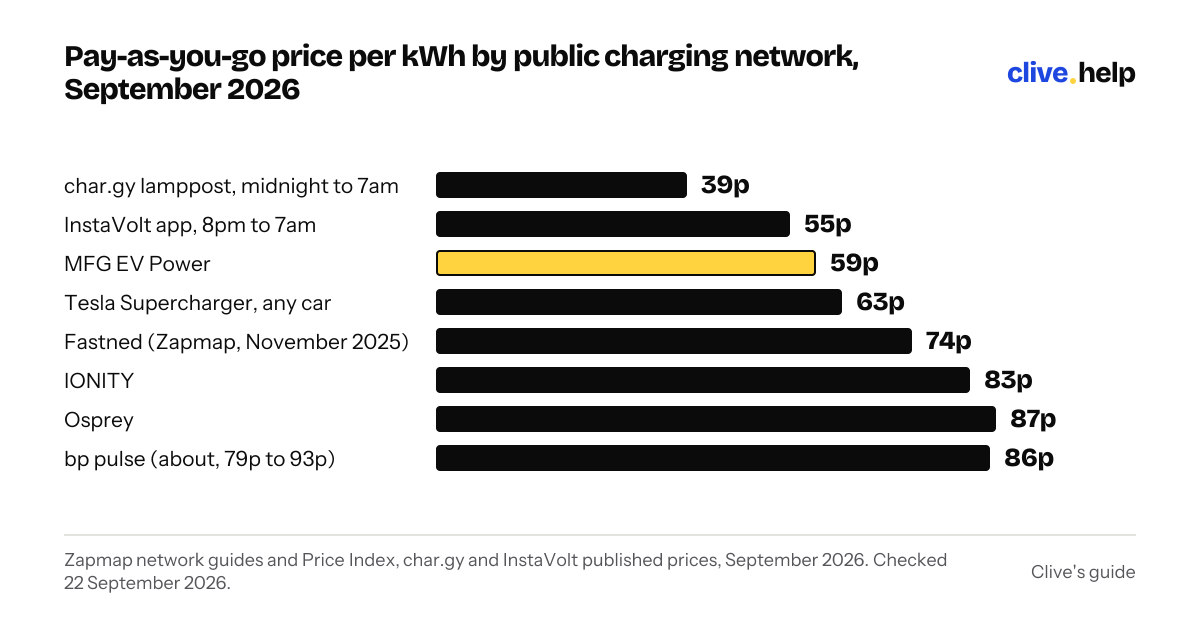
For rapid charging, MFG EV Power at 59p a kWh and Tesla Superchargers at 63p are the cheapest of the big networks in September 2026, and InstaVolt's app rate of 55p after 8pm beats both. Osprey, GRIDSERVE and bp pulse are 85p to 93p. On slow chargers, a lamppost after midnight at 39p wins.
Which networks are cheapest per kWh?
MFG EV Power at 59p, Tesla at 63p and Fastned at 74p are the cheapest rapid networks by the card price, against 83p to 93p at IONITY, InstaVolt, Osprey, GRIDSERVE and bp pulse.
The table below is every big network's pay-as-you-go price in September 2026, from Zapmap's network guides, turned into pence per mile at 3.4 miles per kWh. The UK average for a rapid was 77p a kWh in August 2026, so anything under that is a good deal and anything over 85p is the price of convenience.
Three things jump out. The cheapest rapids are at petrol stations and supermarkets, not motorway services: MFG's forecourts are 59p, and Tesco's Pod chargers are 62p to 69p on Chargenet's list for 22 September 2026. Tesla's Superchargers, open to any car with a CCS socket, are 63p for everyone and 46p for Tesla drivers. And the networks with the best motorway coverage, GRIDSERVE, Osprey, InstaVolt and bp pulse, are all 85p and up by card, which is 25p to 27p a mile and more than petrol.
For slow and fast chargers the picture is the one in the cost guide: a lamppost after midnight at 39p (char.gy) or 44p (ubitricity) is the cheapest public electricity there is, a supermarket 7kW post is 59p to 72p, and the UK average was 54p.
Why do rapid chargers cost more?
A rapid charger pays 20% VAT where your house pays 5%, sits on a grid connection that costs six figures, and has to earn that back from a car every hour.
The electricity is the same. What's different is everything around it. Home charging is taxed as domestic energy at 5% VAT; public charging is a commercial supply at 20%, so a fifth of every public price is tax before a network has bought a single kWh. Zapmap worked out that a driver with a driveway paid about £48 a year in charging VAT in 2025, and a driver without one about £194.
Then there's the kit. A 150kW charger needs a grid connection big enough to run a small factory, and a bay it can sit in for twenty years. That money comes back a car at a time, so a charger that's empty for half the day charges more per kWh when it's busy. A lamppost charger, by contrast, is a socket on a wire that was already there, which is why 39p is possible on the street and impossible at the services.
Read a rapid price as a price for time. You're paying 25p a mile to get 100 miles in twenty minutes. If your car sleeps on the street anyway, an overnight lamppost at 11p a mile is the better bargain, and a rapid is for the week that went wrong.
Pay-as-you-go prices by network in September 2026, and what a mile costs at 3.4 miles per kWh.
| Network | Type | Price per kWh | Cost per mile |
|---|---|---|---|
| char.gy, midnight to 7am | Lamppost | 39p | 11p |
| ubitricity, midnight to 7am | Lamppost | 44p | 13p |
| InstaVolt app, 8pm to 7am | Rapid | 55p | 16p |
| MFG EV Power | Rapid | 59p | 17p |
| Lidl Plus app | Fast | 59p | 17p |
| Tesco (Pod) | Fast and rapid | 62p to 69p | 18p to 20p |
| Tesla Supercharger, any car | Rapid | 63p | 19p |
| Believ | Fast | 66p | 19p |
| Sainsbury's Smart Charge | Fast and rapid | 72p | 21p |
| Fastned (Zapmap price, November 2025) | Rapid | 74p | 22p |
| Shell Recharge | Rapid | 74p to 89p | 22p to 26p |
| IONITY | Rapid | 83p | 24p |
| InstaVolt, card | Rapid | 85p to 92p | 25p to 27p |
| GRIDSERVE | Rapid | 85p to 92p | 25p to 27p |
| Osprey | Rapid | 87p | 26p |
| bp pulse | Rapid | 79p to 93p | 23p to 27p |
Zapmap network guides, updated September 2026, and the Zapmap Price Index for August 2026; Chargenet's price list for 22 September 2026 for Tesco, Lidl and Believ; char.gy and ubitricity published prices; InstaVolt's off-peak announcement. Fastned's Zapmap price was last checked in November 2025. Last checked 22 September 2026.
Do subscriptions and memberships make it cheaper?
Yes, by 10p to 34p a kWh, but only IONITY's and Tesla's plans pay for themselves for someone who rapid-charges once a week.
Every network would rather you used its app than your card, and the discounts are real. The ones worth knowing about, in September 2026:
- InstaVolt: free, and the best of them. Pay through the app or its RFID card and the price is 55p a kWh from 8pm to 7am since April 2026, against 85p to 92p by card in the day. No monthly fee. If you can plug in after tea, it turns the dearest network into one of the cheapest.
- Tesla: about £9 a month, reported. Tesla doesn't publish the fee on a page I could check, and reports from June 2026 put it at £8.99 or £9.99. Non-Tesla drivers pay 63p by default; the membership typically takes about 10p a kWh off, more at some sites, and Tesla's own off-peak hours cut it further. It pays back at two or three rapid charges a month.
- IONITY Passport. The card price is 83p. In September 2026 Passport Motion is £5.49 a month for 62p; Passport Power is £10.50 a month for 49p. The annual versions are cheaper still: Power 365 is £86.99 a year for 47p a kWh. At one 40kWh charge a week, Power saves you about £55 a month for a £10.50 fee.
- Octopus Electroverse. One card and app for most networks. It isn't a discount on its own, but Octopus Go customers get 5% offeverything through it and Intelligent Octopus Go customers 8%, and on “plunge pricing” days, when the wind is blowing and demand is low, it has knocked 15% to 45% off at IONITY, Osprey, Be.EV and others with a day's notice.
- bp pulse and the rest. bp pulse sells a monthly plan and Fastned a gold membership; both are on their apps, and both move the price down from the top of the table rather than to the bottom of it. Do the sum on your own miles before you sign up to anything monthly.
The rule of thumb: a plan is worth it when the saving per kWh times the kWh you buy in a month is more than double the fee. For one rapid charge a week, that's IONITY Power and Tesla, and nothing else.
Which apps show live prices?
Zapmap shows the price on almost every public charger in the UK before you drive to it, and Electroverse shows it for the ones it can pay for.
Prices change often, sometimes by the hour, so a table like the one above is a starting point and the app is the answer. Two do the job.
- Zapmap. The map most drivers use. Tap a charger and it shows the price per kWh, the speed, whether it's working, and whether someone's on it. The price index it publishes each month is where the 54p and 77p averages on this page come from.
- Octopus Electroverse. A map and a payment card in one. It shows the price you'll actually pay through it, discount included, and it puts every network on one monthly bill, which is worth something on its own when you're juggling five apps.
- The network's own app. Only ever for the discount. InstaVolt's 55p, IONITY's Passport and Tesla's membership all need the network's app, not a third party's.
One habit saves more than any app: look at the price before you plug in, not after. A 59p charger two streets from a 92p one is a 10p-a-mile difference, and it's on the map.
Which is cheapest for a weekly top-up without a driveway?
A lamppost after midnight if you have one, then InstaVolt after 8pm, then MFG or Tesla in the day; the motorway networks only when you're on the motorway.
If you're running an EV without a plug of your own, this is the order I'd try. A char.gy or ubitricity post after midnight is 39p to 44p a kWh, which is 11p to 13p a mile and the closest thing to a home rate on the street. If there isn't one, an InstaVolt after 8pm on the app is 55p, or 16p a mile, and it takes twenty minutes rather than all night. In the day, MFG's forecourts at 59p and a Tesla Supercharger at 63p are the two to steer towards.
A 40kWh weekly charge, about 135 miles, comes to £16 on the lamppost, £22 at InstaVolt off-peak, £24 at MFG, £25 at Tesla, and £35 to £37 at Osprey, GRIDSERVE or bp pulse. Over a year that's the difference between £810 and £1,930 for the same miles. The weekly routine shows what that looks like day by day, and the battery guide answers the question everyone asks next.
Sources
- Zapmap network guides: InstaVolt, GRIDSERVE, Osprey, IONITY, Tesla, MFG EV Power, Shell Recharge, bp pulse, Fastned, Be.EV and Smart Charge, prices updated September 2026, checked 22 September 2026
- Zapmap Price Index, August 2026, checked 21 September 2026
- Chargenet: latest UK rapid charging prices, 22 September 2026, checked 22 September 2026
- InstaVolt: 55p off-peak rate for app users, 22 April 2026, checked 22 September 2026
- IONITY: UK Passport subscription prices, checked 22 September 2026
- Car Deal Expert: Tesla Supercharger membership, is £8.99 worth it? (June 2026), checked 22 September 2026
- Octopus Electroverse: discounts for Octopus Go customers, checked 22 September 2026
- Octopus Energy: Electroverse Plunge Pricing, checked 22 September 2026
- Zapmap: the VAT gap between public and home charging, August 2026, checked 22 September 2026
- Zapmap network guide: char.gy prices, checked 21 September 2026
- ubitricity: pricing from 1 April 2026, checked 21 September 2026
Read next
- Can you own an EV without a driveway? The honest answer.Yes for many UK drivers, if chargers are a short walk from home or at work. What a mile costs against a driveway, the weekly routine, and when to wait.
- Public vs home charging: what a mile really costsHome off-peak charging costs about 2p a mile, a lamppost charger 11p to 19p, a rapid 23p. The price per kWh for each, the sums, and how to cut the bill.
- Rapid charging once a week: is it bad for the battery?Weekly rapid charging costs about half to one percent of battery a year, not the range people fear. The fleet data, the 80% rule, heat and the warranty.
- Terraced house, no driveway: a real weekly charging routineA week of EV charging from a terraced street: one overnight lamppost charge, a top-up at the shop, a rapid when it runs long. What it costs and takes.