Rapid charging once a week: is it bad for the battery?
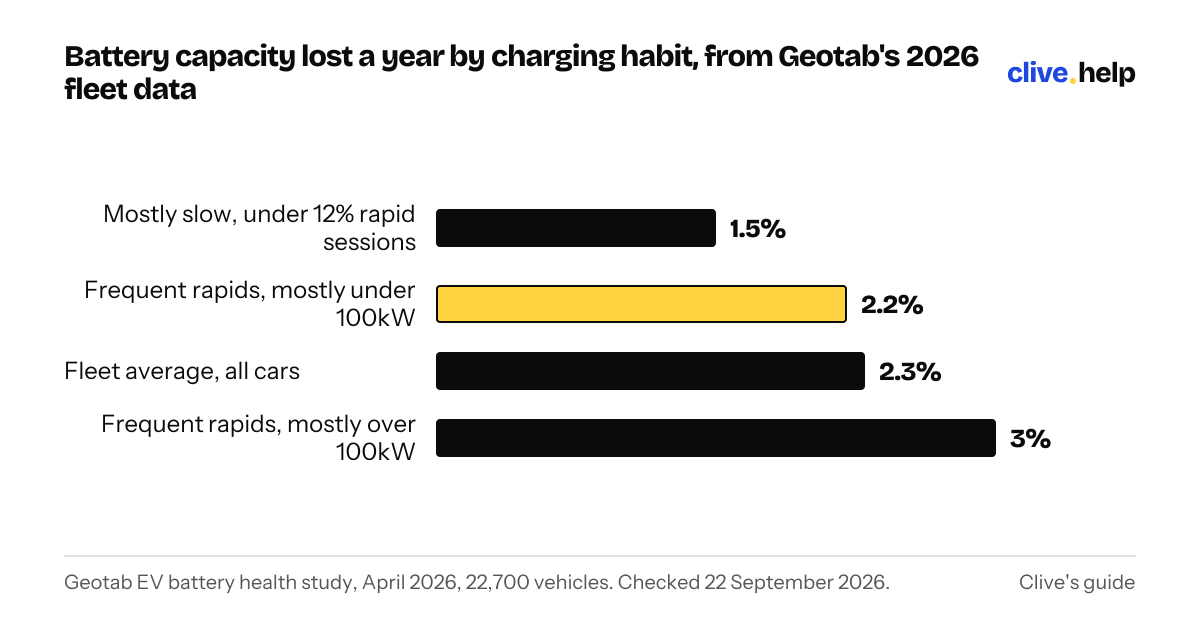
Not much. The biggest fleet study, 22,700 EVs in 2026, found cars that rapid charge often lose 2.2% of their battery a year on 50kW chargers and 3.0% on ultra-rapids, against 1.5% for cars that mostly charge slowly. Over 8 years that's 88% against 76% of your range, and the big makers' warranties cover you down to 70%.
What does the data say about rapid charging and battery life?
Cars that rapid charge often lose 2.2% to 3.0% of their battery a year against 1.5% for cars that mostly charge slowly, so the habit costs you between half and one and a half percent a year.
The best numbers come from Geotab, which watches 22,700 EVs of 21 different models through their telematics. In its April 2026 update the average car lost 2.3% of its battery a year. Cars that did fewer than 12% of their charges on a DC rapid lost 1.5% a year. Cars that rapid charged more often than that, but mostly on chargers under 100kW, lost 2.2%. Cars that leaned on ultra-rapids above 100kW for a lot of those sessions lost 3.0%. That last group is the one to notice: it's double the slow-charging rate.
Recurrent found less. It looked at 13,000 Teslas over five or six years and found no statistically significant difference in range loss between cars fast charged more than 70% of the time and cars fast charged less than 30% of the time. Teslas manage their batteries well, so the fair reading is that rapid charging costs you something, the amount depends on the car, and it's a slow tax rather than a cliff.
For the bigger picture, Recurrent's 30,000-car dataset shows under 4% of EVs have ever had the battery replaced, and for cars built from 2022 on it's 0.3%. The battery is not the part to worry about.
Why stop at 80%?
Charging slows sharply above 80% on a rapid, and the battery is under most stress when it's very full or very empty, so stopping at 80% saves you time on the day and a little battery over the years.
Two reasons, and the first is about your afternoon, not your battery. A rapid charger pours in power quickly up to about 80% and then the car throttles it back to protect the cells, so the last fifth can take nearly as long as the first four. On a 50kW charger that's 40 minutes to 80% and then a long wait for not many miles. Unplug at 80% and let someone else have the bay.
The second reason is the one people over-worry about. Geotab's January 2026 release found that time spent at extreme charge levels only starts to matter when it's habitual: cars that sat above 80% or below 20% for more than four fifths of their lives degraded at about 2.0% a year rather than 1.5%. Its advice for most drivers is that there's no need to fret about filling or emptying the battery now and then, because every modern EV keeps a hidden buffer at the top and bottom. Recurrent's version is simply to avoid rapid charging when the battery is at 5% or 90%.
So for a weekly rapid: arrive around 20%, leave at 80%, and don't feel guilty about going to 100% the night before a long trip. That's most of the 80% rule in one line.
What each charging habit costs in battery, from Geotab's 2026 fleet data, and what that leaves on a car that did 250 miles when new.
| Charging habit | Battery lost a year | State of health after 8 years | Range left of 250 miles |
|---|---|---|---|
| Mostly slow charging, fewer than 12% of sessions on a rapid | 1.5% | 88% | 220 miles |
| Frequent rapids, mostly under 100kW | 2.2% | 82% (projected) | 206 miles |
| Fleet average, all cars | 2.3% | 82% (projected) | 204 miles |
| Frequent rapids, mostly ultra-rapid over 100kW | 3.0% | 76% | 190 miles |
| Warranty floor, most UK makers | 70% | 175 miles |
Geotab EV battery health study, April 2026, 22,700 vehicles. Eight-year figures for the top and bottom rows are Geotab's own; the middle rows are the yearly rate carried forward. Range column assumes 250 miles when new. Last checked 22 September 2026.
Does hot weather make it worse?
A little: cars in hot climates lose about 0.4% more battery a year, and the fix is to let the car warm or cool its own battery before you plug in.
Heat is the real enemy of a lithium battery, and a rapid charge makes heat. Geotab found cars in hot regions, with plenty of days above 25°C, lost 0.4% more a year than cars in mild ones. Britain is a mild one. A few hot weeks in July won't move your number, but parking in the shade on those days is free.
Cold is the other end, and it's the one you'll actually meet. A cold battery charges slowly and doesn't like being forced. Most newer EVs can pre-condition: they heat or cool the pack to its happy range, which Kia puts at 15 to 35°C, in the 20 to 30 minutes before you arrive at a rapid. Set the charger as the destination in the car's own sat-nav and it does this itself. You get a faster charge, and the battery gets an easier one.
What does once a week actually add up to?
A rapid every week is 52 a year, which puts you in the frequent group, so plan on losing about 2% of your range a year on 50kW chargers and around 3% if you always use the fastest ones.
Here's the sum for the person this page is for: no driveway, one rapid a week, the rest on a lamppost or at work. 52 rapids a year is well past Geotab's 12% line, so you're in the frequent group. If your weekly stop is a 50kW charger at the retail park, that's the 2.2% band. If it's a 150kW ultra-rapid every time, it's nearer 3.0%.
On a car that does 250 real miles new, 2.2% a year is about 5 miles of range gone each year, or 40 miles after eight. At 3.0% it's 60 miles. The table below sets it out. Neither ruins the car; both are worth knowing before you choose which charger to make a habit of, because the slower rapid is usually the cheaper one too. Zapmap's August 2026 average was 77p a kWh for 50kW and above, and the cheapest networks tend to be the slower ones.
Two habits pull you back towards the slow-charging number without a driveway. Take the overnight lamppost charge when you can get it, so more of your sessions are AC: the weekly routine is built around that. And when you do rapid charge, stop at 80%.
What does the battery warranty cover?
Nearly every EV sold in the UK guarantees the battery for 8 years or 100,000 miles, and the big makers promise to repair or replace it if its capacity drops below 70% in that time.
Kia's is the clearest: 8 years or 100,000 miles, whichever comes first, and if the battery falls below 70% of its original capacity they fix it or replace it. Hyundai's high-voltage battery is warranted for 8 years or 100,000 miles too. Nissan covers the Leaf and Ariya for 8 years or 100,000 miles, with older pre-2022 Leafs on 5 years or 60,000. Tesla's Model 3 and Y get 8 years and 100,000 miles on the standard-range cars, more on the Long Range ones, to 70%, per Recharged's February 2026 comparison. The warranties usually transfer to the next owner, which is worth knowing if you're buying used.
Now put the two halves of this page together. Even the worst case in Geotab's data, 3.0% a year, leaves you at 76% after eight years, which is still above the 70% line. Rapid charging once a week will not push a healthy battery under its warranty. What it will do is shave a few miles a year off your range, and now you know how many.
Sources
- Geotab: EV battery health, findings from 22,700 vehicles, April 2026, checked 22 September 2026
- Geotab press release: new data on fast charging and degradation, January 2026, checked 22 September 2026
- Recurrent: how fast charging affects battery health, 13,000 Teslas, June 2024, checked 22 September 2026
- Recurrent: how long EV batteries last, 30,000 cars, November 2025, checked 22 September 2026
- Kia UK: electric car battery warranty, checked 22 September 2026
- Hyundai UK: warranty, checked 22 September 2026
- Nissan UK: electric car FAQ, battery warranty, checked 22 September 2026
- Recharged: EV battery warranty comparison by brand, February 2026, checked 22 September 2026
- Kia UK: what is EV battery pre-conditioning?, checked 22 September 2026
- Zapmap Price Index, August 2026, checked 21 September 2026
Read next
- Can you own an EV without a driveway? The honest answer.Yes for many UK drivers, if chargers are a short walk from home or at work. What a mile costs against a driveway, the weekly routine, and when to wait.
- Terraced house, no driveway: a real weekly charging routineA week of EV charging from a terraced street: one overnight lamppost charge, a top-up at the shop, a rapid when it runs long. What it costs and takes.
- The cheapest public charging networks in the UKMFG at 59p and Tesla at 63p a kWh are the cheapest rapid networks by card, and InstaVolt is 55p after 8pm on its app. Every big name ranked per mile.